
AIR FREIGHT
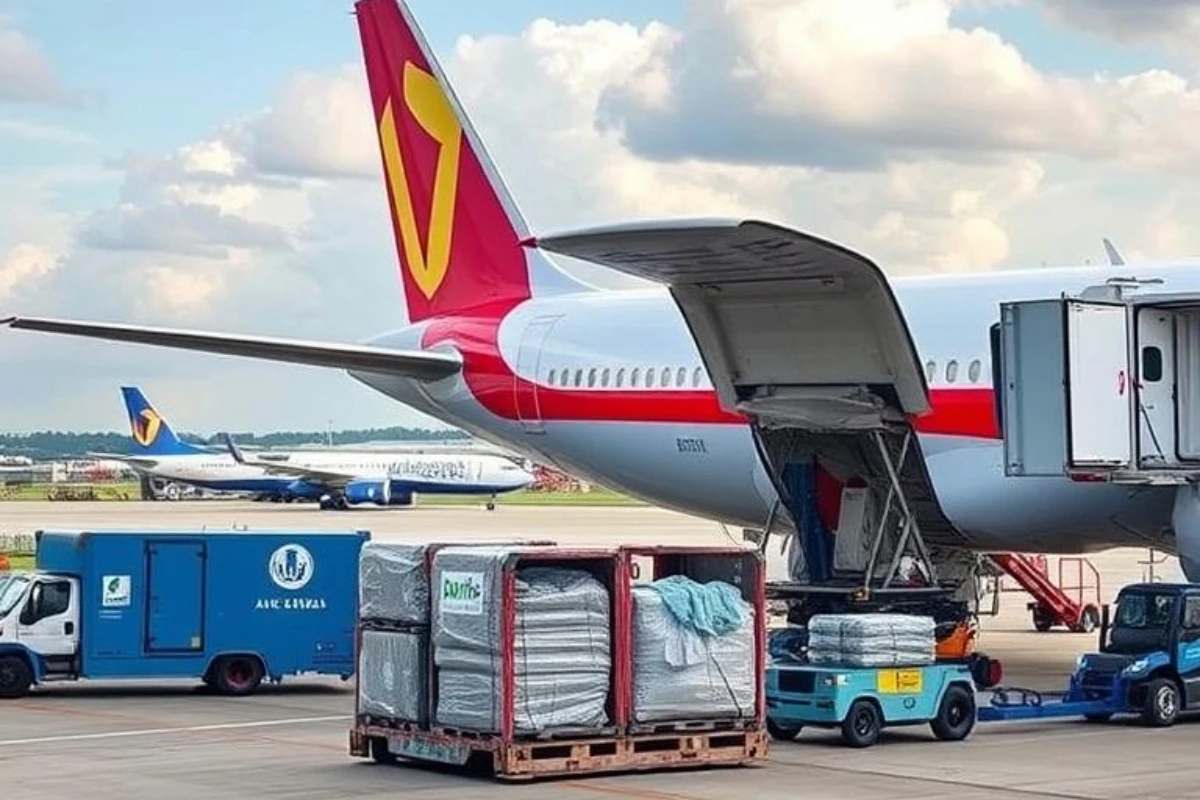
Air freight (air cargo) is the transportation of goods or passengers between locations using aircraft – including passenger planes, cargo jets, or charter flights. Known for its exceptional speed and time-critical delivery, it’s essential for international trade, cross-border e-commerce, urgent logistics, and high-value shipments.
Air Freight's Role in Global Transport
Air cargo is a vital part of the global transport network, offering unmatched efficiency, reliability, and security. While ocean freight handles most global volume, air transport plays a crucial role in time-sensitive international trade, supply chain management, and emergency logistics.
Despite higher costs, nothing beats air freight for speed, worldwide reach, urgent deliveries, and transporting valuable goods. As globalization and digitalization accelerate, air cargo will only grow more important, fueling international commerce and economic growth.
Why Choose Air Freight?
✅Unmatched Speed
The fastest shipping option – perfect for urgent or time-sensitive goods.
International delivery typically takes 1–3 days, far outpacing sea or land transport.
✅Truly Global Reach
With extensive airline networks spanning countries and continents, we bridge global origins and destinations with seamless efficiency.
✅Enhanced Security
Minimal cargo damage with limited handling.
Rigorous security screening and tracking systems ensure safe transit.
✅Ideal for High-Value Items
For high-value shipments such as electronics, precision instruments, and jewelry, this option stands out as the most reliable choice.
✅Reduces Inventory Costs
Faster transit shrinks supply chain timelines, and this reduction subsequently lowers warehousing expenses.
Air Freight Limitations
⚠️Higher Costs
Significantly more expensive than sea/land options due to fuel, airport fees, and handling charges.
⚠️Size & Weight Restrictions
Due to limited aircraft space, oversized, overweight, or bulk shipments are impractical.
⚠️Weather Vulnerable
Storms, fog, or other severe conditions can delay or cancel flights.
⚠️Environmental Impact
Higher carbon emissions than other transport modes (though the industry is actively improving sustainability).
⚠️Infrastructure Dependent
Requires airports and flight routes – remote areas may need ground transportation connections.
What Affects Air Freight Costs?
Chargeable weight (actual vs. volumetric)
Route (direct flights cost more than transits)
Fuel prices (surcharges fluctuate)
Airline fees (peak season/special handling)
Customs duties at destination
Seasonal demand (higher in peak periods)
The Difference Between Freighter Aircraft and Passenger Aircraft Cargo Space in Air Freight
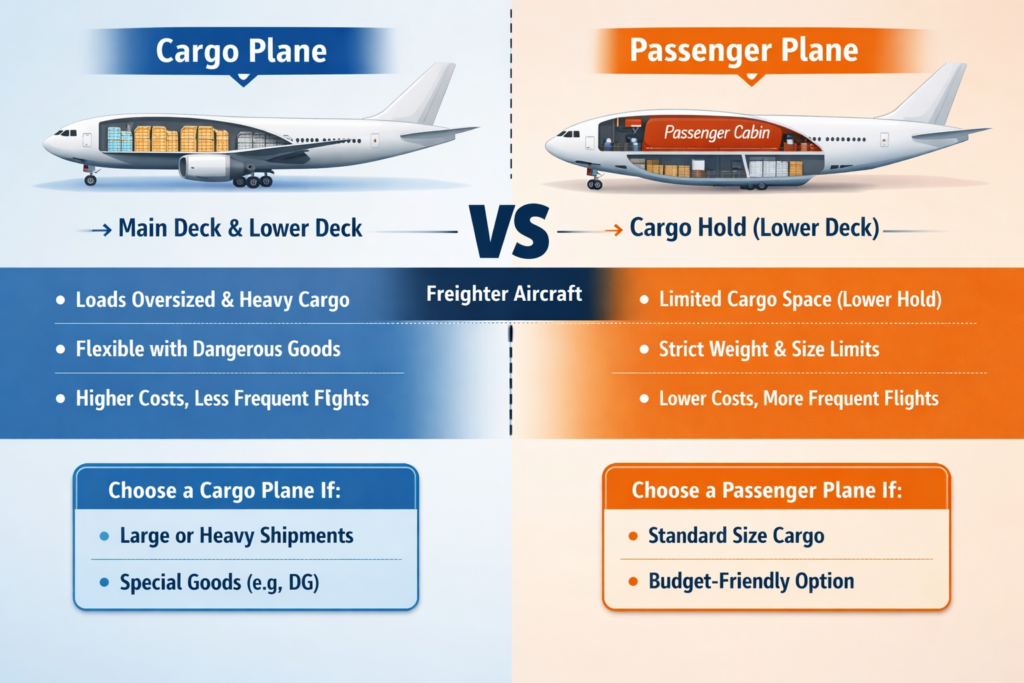
In air freight, airlines use both dedicated freighter aircraft and passenger aircraft with belly cargo space, and each option serves different logistics needs. Freighter aircraft such as the Boeing 777F operate exclusively for cargo, which means they load freight on the main deck and lower deck, handle oversized or heavy shipments, and accept more flexible dangerous goods categories.
In contrast, passenger aircraft like the Boeing 777 carry cargo only in the lower hold beneath passengers, so space, height, and weight restrictions are stricter; however, airlines schedule these flights more frequently, which often results in lower costs and faster departures on major routes. Therefore, if you ship large, heavy, or special cargo, you should choose a freighter, but if your goods fit standard dimensions and you want to control budget, passenger belly cargo usually provides a more economical solution.
Understanding Volumetric Weight
How It Works:
Calculate Volumetric Weight
(Length [cm] × Width [cm] × Height [cm]) ÷ Volumetric Divisor
Standard divisor: 6,000 (some airlines use 5,000)
Determine Chargeable Weight
Chargeable Weight = Higher of (Actual Weight vs. Volumetric Weight)
Example:
A shipment measures 100cm × 80cm × 60cm, actual weight 200kg:
Volumetric weight = (100cm × 80cm × 60cm) ÷ 6,000 = 80kg
Chargeable weight = 200kg (actual weight is higher)
Key Tips:
- Confirm divisor first
- Optimize packaging to reduce wasted space
- Measure dimensions accurately to avoid billing disputes
Air freight Pallet Requirements
Materials
Wood: Must comply with ISPM-15 (heat-treated/fumigated)
Plastic: Lightweight & reusable (higher cost)
Paper: Eco-friendly single-use option (lower weight capacity)
Dimensions Common standards:
Europe: 1200×800mm (47×31 in)
USA: 1220×1016mm (48×40 in)
Max. height with cargo: 163cm (64 in)
Load Capacity
Must support cargo weight without bending/breaking
Non-Slip Surface
Prevents load shifting during transit
Air Cargo Packaging Guidelines
Materials:
Cartons (lightweight items)
ISPM-15 wooden crates (heavy/fragile goods)
Foam boxes (electronics/fragile items)
Sealed plastic bags (moisture/dust protection)
Design Essentials:
Cushioning (bubble wrap/foam inserts)
Water resistance (waterproof tape/sealants)
Immobilized contents (no internal movement)
Special Cargo Rules:
Fragile Items: Multi-layer padding + “FRAGILE” labels
Liquids: Leak-proof containers + “LIQUID” markings
Batteries: UN-certified packaging + MSDS documentation
Major international airports in China
China has several worldwide airports, which are not the best vital hubs for domestic air transportation, but also key nodes connecting the world. The following are China’s most important global airports and their characteristics:
1. Shanghai Pudong International Airport (PVG)
Cargo Volume: China’s biggest shipment airport, one of the top globally.
Geographic Location: Located inside the Yangtze River Delta Economic Zone, radiating East China.
Features: Backed by well-prepared shipment facilities and bonded zones, the region is further strengthened by a dense network of routes connecting major global economies, effectively supporting cross-border e-commerce and high-value cargo transportation.
2. Beijing Capital International Airport (PEK)
Cargo Volume: North China’s largest cargo hub.
Geographic Location: Located in China’s political and economic middle, encompassing the Beijing-Tianjin-Hebei location.
Features: With advanced cold chain logistics facilities in place, the hub is well-positioned to support the transportation of high-value and time-critical shipments. In parallel, its development in tandem with Daxing International Airport continues to enhance overall cargo handling capacity.
3. Guangzhou Baiyun International Airport(CAN)
Cargo Volume: South China’s largest cargo airport.
Geographic Location: Located in the Pearl River Delta Economic Zone, adjacent to Hong Kong and Macau.
Features:
FedEx’s primary transshipment hub in the Asia-Pacific region.
Supports cross-border e-commerce and manufacturing exports.
Dense routes connecting Southeast Asia, South Asia, and Africa.
4. Shenzhen Bao'an International Airport (SZX)
Cargo Volume: A key cargo hub in South China.
Geographic Location: Located in the Pearl River Delta Economic Zone, adjacent to Hong Kong.
Features:
A key channel for the export of high-tech products.
Broad-border e-commerce and cold chain
5. Hong Kong International Airport (HKG)
Cargo Volume: One of the world’s busiest cargo airports.
Geographical Location: Located in the Pearl River Delta, the mainland connects China to global markets.
Features: Bridging cost-efficient sea and air-land transportation with integrated intermodal solutions, while seamlessly supporting higher-value cargo and cross-border e-commerce logistics.
6. Chengdu Shungliu International Airport (CTU)
Cargo Volume: The largest cargo hub in South-West China.
Geographical Location: Located in South-West China, in the Chengdu-Chongqing Economic Circle.
Features: A major hub connecting Europe, Southeast Asia, and the Middle East. Supporting the transport of high-value goods such as electronics and pharmaceuticals. The inauguration of Tianfu International Airport has further enhanced cargo capacity.
7. Zhengzhou Xinzheng International Airport (CGO)
Cargo Volume: One of China’s important cargo hubs.
Geographic Location: Located in the Central Plains Economic Zone, radiating to the central region.
Features:
Cross-border e-commerce and cold chain logistics are developing rapidly. Possessing a comprehensive international cargo route network.
8. Chongqing Jiangbei International Airport (CKG)
Cargo Volume: A key cargo hub in southwest China.
Geographic Location: Located in the Chengdu-Chongqing Economic Circle, radiating to western China.
Features: A key node connecting Europe, Southeast Asia, and the Middle East. Supporting the export of manufacturing industries such as electronics and auto parts. Cross-border e-commerce and bonded logistics are developing rapidly.
9. Hangzhou Xiaoshan International Airport (HGH)
Cargo Volume: A major cargo hub in East China.
Geographic Location: Located in the Yangtze River Delta Economic Zone, servicing Zhejiang and surrounding areas.
Features: Given its role as a key channel for cross-border e-commerce and express logistics, this mode of transport not only facilitates the movement of high-value-added products but also ensures the safe delivery of temperature-sensitive fresh goods.
10. Xi'an Xianyang International Airport (XIY)
Cargo Volume: The largest cargo hub in Northwest China.
Geographic Location: Located in Northwest China, this hub plays a key role in servicing countries along the Belt and Road Initiative.
Features: A major cargo hub connecting Central Asia and Europe. Supports cross-border e-commerce and manufacturing exports.
China’s major international cargo airports are located in the economic territories across the country, creating a global air cargo network. These airports not only support the transport of high-value-added goods, across-border e-commerce, and emergency supply, but also promote China’s deep integration with the global economy through comprehensive features and route networks.
The main airlines that air cargo from China
When you ship cargo by air from China, several major airlines dominate the main international routes, and each carrier offers distinct advantages. First, Chinese carriers such as Air China Cargo, China Southern Airlines, and China Eastern Airlines operate extensive networks from hubs like Shanghai, Guangzhou, and Beijing to North America and Europe; they provide strong capacity, competitive pricing, and stable uplift during peak seasons. Meanwhile, international cargo specialists such as Lufthansa Cargo and Cargolux connect major Chinese gateways with Frankfurt and Luxembourg, and they focus on high-value, automotive, and special cargo with strict operational standards.
In addition, Middle Eastern carriers like Emirates SkyCargo and Qatar Airways Cargo link China to Europe, Africa, and the Americas via Dubai and Doha; they offer flexible transfer options and wide global coverage. Therefore, shippers should evaluate route frequency, transit time, cargo type, and pricing structure before selecting the most suitable airline for shipments from China.
Shipping from China: Step by Step
1. Prepare Goods
Before shipment, ensure full compliance with airline handling requirements by packing the cargo securely, clearly labeling the contents and destination, and accurately measuring the dimensions and weight.
2. Choose Logistics Partner
Depending on your shipment needs, you can choose between a freight forwarder for door-to-door convenience or an airline direct option, which is best for large volumes.
3. Book Space
From providing shipment details to selecting flight options, complete the process and receive your booking confirmation effortlessly.
4. Warehouse Processing
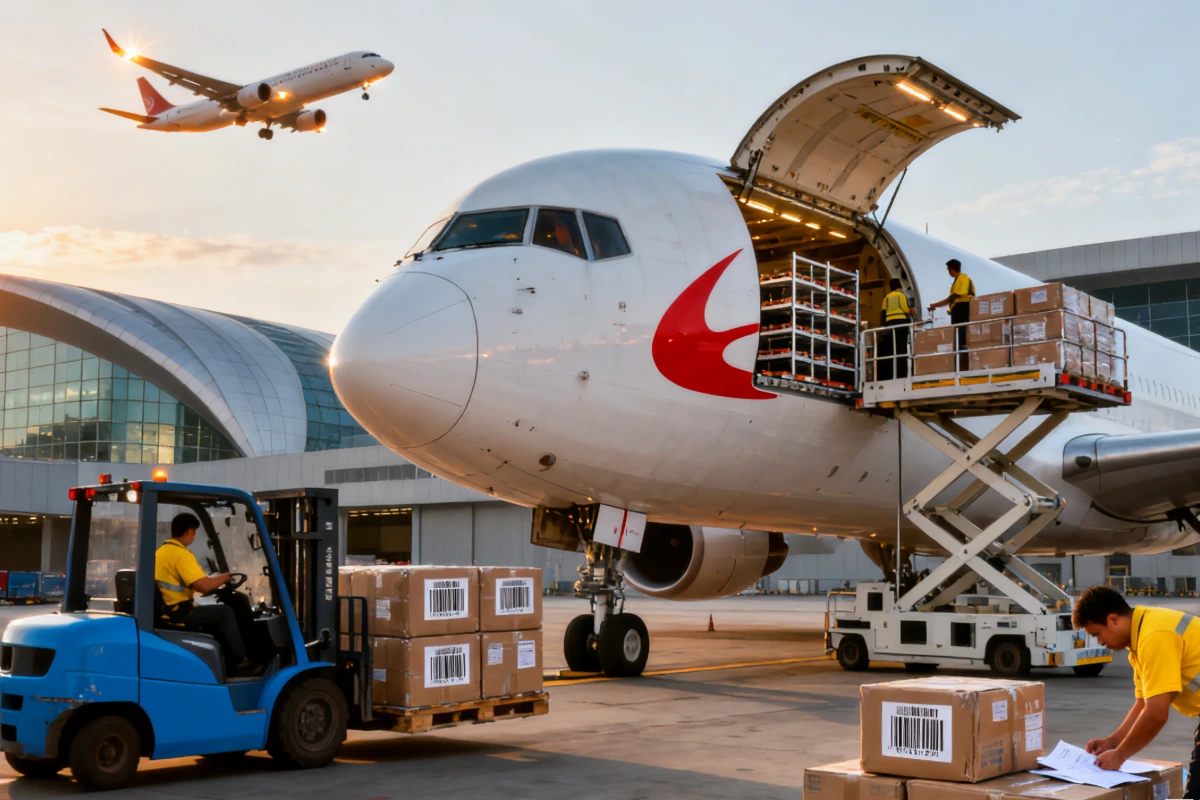
After delivery to the designated facility, the shipment undergoes security screening and weight verification, followed by palletizing and container loading.
5. Export Customs
Please submit the required documents, such as the invoice and packing list, complete the export formalities, and cooperate in the event an inspection is required.
6. Transit & Tracking
Once the aircraft is loaded, we provide real-time shipment monitoring to keep you updated at every step.
7. Import Customs
At the destination, clear the goods, pay any applicable duties or taxes, and provide documentation if required for inspection.
8. Final Delivery
Pick up from the airport, arrange door-to-door service, and confirm receipt—all in one seamless process.
Pro Tips:
Double-check documentation
Declare special cargo (batteries/liquids) upfront
Consider transit time vs. cost tradeoffs
Insure high-value shipments
Why Choose ApexLink Shipping Air Freight?
Speed & Flexibility
Instant booking confirmations
Optimal routes (direct/transit/charter)
Priority handling for urgent shipments
Cost Efficiency
This is further strengthened by discounted rates through trusted airline partnerships.
Tailored solutions matching cargo needs
Specialized Expertise
Oversized, dangerous, temperature-sensitive, and regulated goods
Full compliance with airline & customs regulations
End-to-End Service
Single point of contact for:
✓ Pickup ✓ Customs ✓ Booking
✓ Documentation ✓ Final delivery
Risk Management
Real-time monitoring & issue resolution
Cargo insurance options
We simplify air freight through established partnerships with leading carriers, such as Air China, delivering cost-effective solutions with operational flexibility.