
CERTIFICATE OF ORIGIN (CO) FOR SHIPPING FROM CHINA
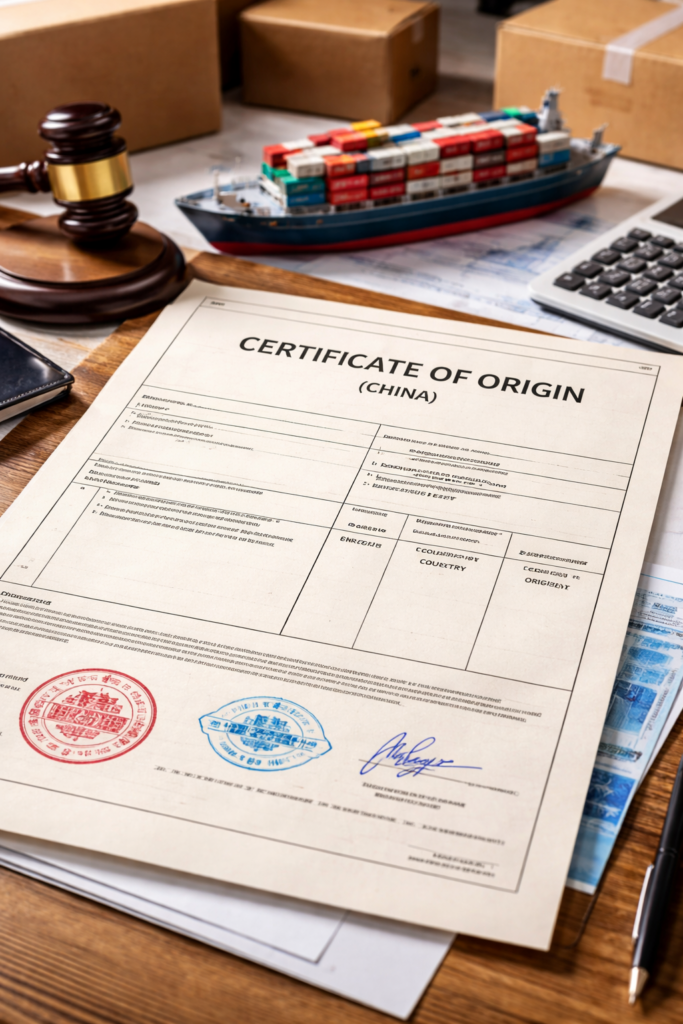
When you export goods from China, a Certificate of Origin (CO) does more than confirm where your products are made—it directly influences tariffs, compliance, and even whether your shipment clears smoothly.
In practice, many import procedures rely on origin documentation. Therefore, if you choose the wrong CO type or submit inconsistent data, customs authorities may delay your cargo or reject preferential tariffs.
What Is a Certificate of Origin?
A Certificate of Origin (CO) is an official trade document issued by an authorized body in the exporting country. It certifies the manufacturing origin of goods and allows customs authorities to apply the correct duty rates and trade policies.
In international logistics, this document serves three key roles:
It determines whether your cargo qualifies for reduced or zero tariffs.
It supports customs compliance and inspection.
It verifies that goods are not subject to trade restrictions or anti-dumping measures.
Although a CO is not always mandatory, importers often request it to reduce costs under Free Trade Agreements (FTAs).
Why Certificate of Origin Matters in Shipping
Many exporters underestimate the strategic value of a CO. However, in real operations, it directly impacts your supply chain.
1. Tariff Optimization
If you apply the correct preferential CO, your buyer may significantly reduce import duties. For example, under FTAs, goods can qualify for lower tariffs if they meet origin rules.
2. Customs Clearance Support
Although CO is not the only document required, some countries treat it as mandatory. Without it, customs may hold or reclassify your shipment.
3. Risk Control & Compliance
Customs authorities use CO to detect origin fraud, anti-dumping violations, or sanctions-related risks.
4. Trade Data & Traceability
Governments also use CO data to track import sources and enforce trade policies.
Types of Certificate of Origin (China Export)
Choosing the correct CO type is critical. Each form corresponds to a specific trade agreement or purpose.
1. General Certificate of Origin (Non-preferential CO)
Confirms the country of origin only
Does not provide tariff benefits
Typically issued by CCPIT or customs authorities
This type is commonly used for standard shipments where tariff reduction is not required.
2. Preferential Certificates of Origin
Preferential COs allow importers to claim reduced or zero duties under FTAs.
Common examples include:
FORM E – China–ASEAN trade
China–Australia CO – bilateral agreement
China–Korea CO – tariff reduction programs
FORM F – China–Chile trade
However, policies change frequently. For instance, some regions have already phased out older schemes like GSP for China.
3. Special-Purpose Certificates
Certain industries require additional origin proof, such as:
Tobacco authenticity certificates
Textile-specific origin documents
Re-export or back-to-back COs
These documents often involve stricter verification procedures.
How to Apply for a Certificate of Origin in China
Step 1: Registration
You must register with Chinese Customs or an authorized body before applying.
Step 2: Prepare Documents
You typically need:
Commercial invoice
Packing list
Manufacturer declaration
Proof of raw material origin (for FTA eligibility)
Step 3: Submit Application
Exporters now use the China Single Window system to apply for electronic COs (e-CO).
Step 4: Issuance & Verification
Once approved, the CO can be issued electronically or printed with an official stamp.
Thanks to China’s full digitalization, the process has become faster and paperwork delays are significantly reduced.
Practical Example: Exporting Furniture to Germany
Let’s say a furniture manufacturer in China exports wooden tables to Germany.
If the exporter uses a general CO, the importer pays standard EU tariffs
If the exporter qualifies for a preferential CO (if applicable), the importer may reduce duties
If the origin declaration is incorrect, customs may deny the tariff benefit and impose penalties
In real scenarios, even small inconsistencies—such as mismatched HS codes or supplier declarations—can invalidate the CO.
Advanced Insight: Rules of Origin (Often Overlooked)
Many exporters focus on getting the CO but ignore the Rules of Origin (ROO) behind it.
In reality, customs authorities verify:
Wholly obtained goods (WO)
Regional Value Content (RVC)
Change in Tariff Classification (CTC)
If your product fails these criteria, your CO may be rejected—even if the document itself is correctly issued.
This is why experienced exporters prepare origin calculation sheets before applying.
Digital Trend: e-CO and Self-Certification
Modern trade agreements increasingly allow self-certification instead of traditional CO issuance.
For example:
Approved exporters can issue origin declarations directly
Authorities verify data electronically across countries
This reduces processing time and administrative costs
However, this system requires strong compliance records and internal documentation control.
Key Tips to Avoid CO Problems
Ensure all documents match exactly (invoice, B/L, packing list)
Apply 3–5 days before shipment
Select the correct FTA and CO type
Monitor policy updates in destination countries
Keep supplier declarations on file for audits
A small mistake in origin data can delay your shipment more than a missing document.
FAQ: Certificate of Origin (CO)
Q1: Is a Certificate of Origin mandatory for all shipments?
No. You can export without a CO unless the importing country or buyer requires it. However, without it, you cannot claim tariff benefits.
Q2: Can I apply for a CO after shipment?
Yes, but late applications require additional justification and documents. The process is more complex and may delay customs clearance.
Q3: What happens if the CO information is incorrect?
Customs may reject the document, deny preferential tariffs, or even impose penalties depending on the severity.
Q4: Can a third party issue the CO?
In some cases, yes—especially if the Letter of Credit allows third-party documentation. However, this must be confirmed in advance.
Q5: What is the difference between preferential and non-preferential CO?
A non-preferential CO only proves origin, while a preferential CO allows duty reductions under FTAs.
Tips
That said, a Certificate of Origin is far more than a routine document—it plays a key role in shaping costs, compliance, and delivery outcomes.
If you plan your CO correctly, you can reduce tariffs, speed up customs clearance, and minimize risks. On the other hand, if you treat it as a routine document, it can quickly become the weakest link in your shipping process.