
Shipping from China to South Korea
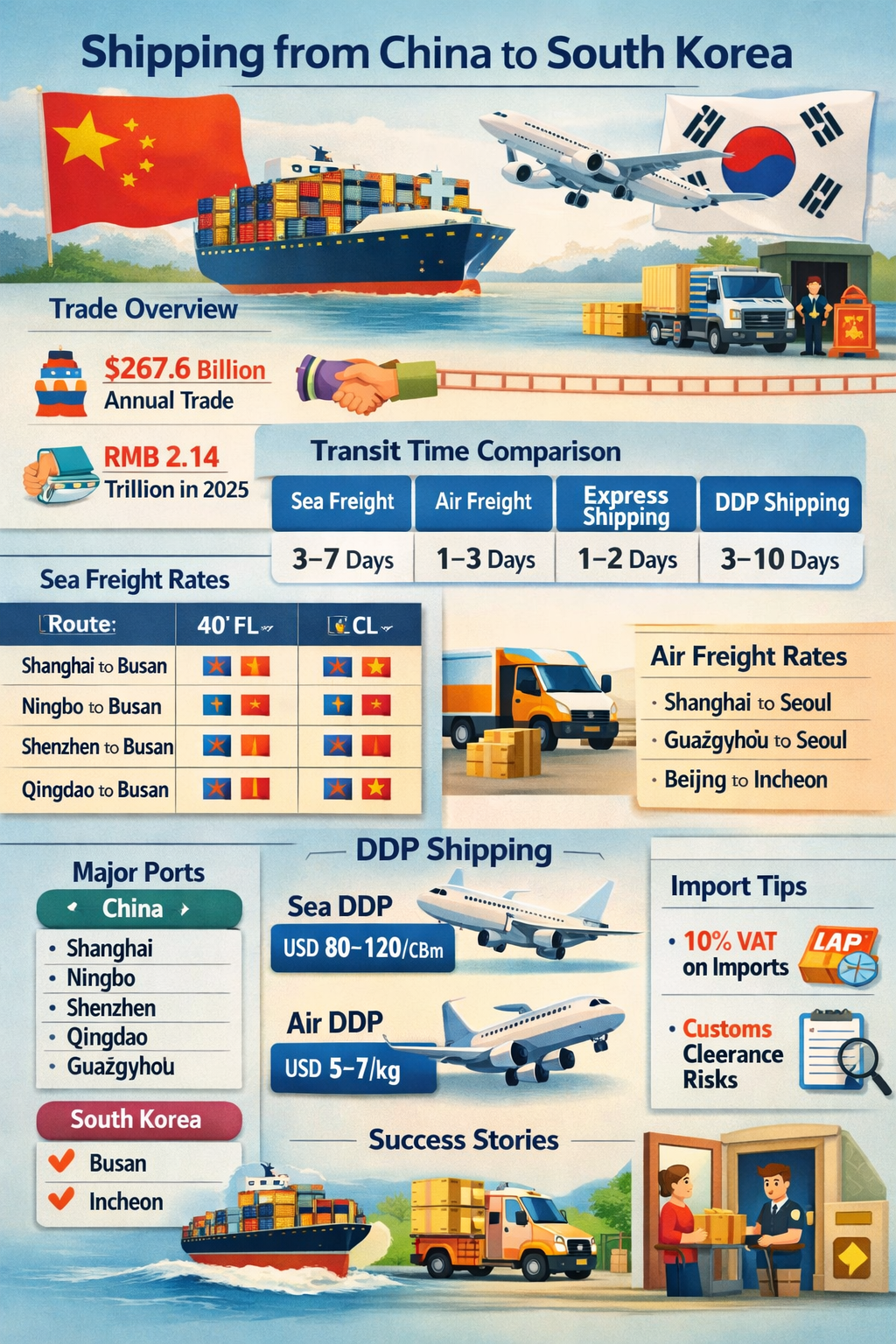
Shipping from China to South Korea is usually fast, flexible, and cost-efficient. The route is short, the trade volume is strong, and the logistics network is mature. China and South Korea also continue to trade at a very high level, which keeps sea freight, air freight, express, and DDP services active all year round. In the first 11 months of 2025, bilateral trade reached RMB 2.14 trillion, while 2024 full-year trade was USD 267.6 billion.
For importers, the real question is not whether to ship, but which shipping method fits the cargo, budget, and delivery deadline. That is where a clear route comparison helps.
China and South Korea Trade Overview
China and South Korea are deeply linked by manufacturing, electronics, chemicals, machinery, and consumer goods trade. China exports large volumes of industrial and consumer products to South Korea, while South Korea ships semiconductors, petrochemicals, and precision components to China. Because both markets rely on each other’s supply chains, freight demand on this lane stays stable and frequent.
This matters for logistics. A route with this level of trade usually has more sailing options, more air cargo capacity, and better consolidation choices for small shipments. In practice, that means better speed and more flexible pricing for shippers.
Transit Time by Shipping Method
| Shipping Method | Typical Transit Time | Best For |
|---|---|---|
| Sea Freight | 3–7 days | Bulk cargo, pallet cargo, low-cost shipments |
| Air Freight | 1–3 days | Urgent cargo, high-value goods |
| International Express | 1–2 days | Samples, documents, small parcels |
| DDP Shipping | 3–10 days | Buyers who want a door-to-door solution |
Sea freight is usually the cheapest. Air freight is the fastest for commercial cargo. Express is ideal for small parcels, while DDP works well when the buyer wants one all-in price with customs and tax handling included.
Sea Freight from China to South Korea
Sea freight is still the most common option for medium and large shipments. It works especially well for industrial cargo, cartons, and palletized goods. On this lane, FCL and LCL both move quickly compared with longer international routes, but the final timeline still depends on sailing schedules and customs handling.
Sea Freight Rates (FCL / LCL)
| Route | 20GP FCL | 40GP FCL | 40HQ FCL | LCL |
|---|---|---|---|---|
| Shanghai → Busan | USD 550–680 | USD 700–850 | USD 720–880 | USD 10–20/CBM |
| Ningbo → Busan | USD 560–690 | USD 710–860 | USD 730–890 | USD 10–20/CBM |
| Shenzhen → Busan | USD 560–720 | USD 700–890 | USD 750–920 | USD 12–22/CBM |
| Qingdao → Busan | USD 600–650 | USD 650–800 | USD 680–830 | USD 10–18/CBM |
| Guangzhou → Busan | USD 610–730 | USD 700–850 | USD 770–950 | USD 12–22/CBM |
Main Container Ports
Major Container Ports in China
The most common export ports for this route include Shanghai, Ningbo-Zhoushan, Shenzhen, Qingdao, and Guangzhou. These are major container gateways and are widely used for Northeast Asia shipping.
Major Container Ports in South Korea
South Korea’s key container ports are Busan and Incheon. Busan is the country’s main container hub, while Incheon is especially important for cargo serving the Seoul metropolitan area.
Sea Freight Process
A normal sea freight shipment usually follows this flow: booking, cargo pickup, export declaration, container loading, vessel departure, arrival at destination port, import clearance, and final delivery. When the documents are prepared properly, this process is smooth and predictable.
Real Shipping Case
Consignee: Home-appliance distributor in Busan
Shipment Type: LCL sea freight
Cargo: 12 CBM of LED lighting accessories
Route: Shenzhen → Busan
The factory finished production in Shenzhen and handed the cargo to the freight forwarder. After pickup, the goods were consolidated with other shipments and exported on the next available sailing. The vessel reached Busan within the normal short-route transit window, customs clearance followed, and the cargo was delivered to the consignee’s warehouse shortly after.
Result: Lower freight cost, stable transit time, and a good fit for regular inventory replenishment.
Air Freight | Shipping from China to South Korea
Air freight is the better choice when time matters more than cost. It is common for urgent inventory, samples, e-commerce replenishment, and higher-value goods. Standard air freight on this route usually takes 1–3 days, while express-style air movement is even faster.
| Route | Typical Air Freight Rate |
|---|---|
| Shanghai → Seoul/Incheon | USD 2.5–5/kg |
| Guangzhou → Seoul/Incheon | USD 3–5.5/kg |
| Shenzhen → Seoul/Incheon | USD 2.5–5.3/kg |
| Beijing → Seoul/Incheon | USD 3–6/kg |
These are normal market ranges for standard air cargo. The final rate depends on chargeable weight, cargo density, and the airport pair used.
Air Freight Transit Time and Influencing Factors
Air freight usually arrives in 1–3 days. The biggest factors are flight space, cargo type, customs speed, and whether the shipment needs special handling. Dense cargo usually gets better pricing than bulky cargo, because airlines charge by chargeable weight.
Main International Airports
Major Airports in China
Common origin airports include Shanghai Pudong (PVG), Guangzhou Baiyun (CAN), Shenzhen Bao’an (SZX), and Beijing Capital (PEK).
Major Airports in South Korea
The main destination airports are Incheon International Airport (ICN) and Gimpo International Airport (GMP). Incheon is the main international air hub for Korea.
Air Freight Process
Air freight normally moves through booking, airport delivery, security screening, export customs, departure, arrival handling, import clearance, and final delivery. Compared with sea freight, the process is faster, but paperwork accuracy matters more.
Real Shipping Case
Consignee: Seoul-based electronics wholesaler
Shipment Type: Standard air freight
Cargo: 180 kg of mobile accessories
Route: Guangzhou → Incheon
The seller completed production, and the freight forwarder booked the next available space. The shipment cleared export procedures, left the airport on schedule, and arrived in Incheon within the expected air freight window. Customs clearance and final delivery were completed soon after.
Result: Fast replenishment and reduced stock-out risk.
International Express | Shipping from China to South Korea
Express shipping is best for samples, documents, and small commercial parcels. DHL and UPS are the most common choices on this lane, and transit is usually very short. Typical express transit is around 1–2 days, though customs and delivery location can still affect the timeline.
| Carrier | Typical Rate |
|---|---|
| DHL | USD 5.5–7/kg |
| UPS | USD 5–7/kg |
DDP Shipping | Shipping from China to South Korea
DDP shipping is a strong choice when the buyer wants one landed cost and less customs work. Under DDP, the forwarder handles transport, customs clearance, and tax-related arrangements, so the consignee receives the goods with fewer steps to manage.
Available DDP Shipping Methods
You can usually choose:
- Sea freight DDP
- Air freight DDP
- Express DDP
DDP Rates
| DDP Method | Typical Rate |
|---|---|
| Sea DDP | USD 80–120/CBM |
| Air DDP | USD 5–7/kg |
DDP Transit Time and Influencing Factors
Sea DDP is usually faster than long-haul sea routes but slower than air DDP. In most cases, sea DDP takes 3–10 days, while air DDP takes 2–3 days. The main variables are cargo readiness, customs procedures, and the final delivery location.
DDP Shipping Process and an Illustrative Case
The usual flow is cargo pickup, export handling, international transport, import customs clearance, tax settlement by the forwarder, and final door delivery. That makes DDP especially useful for buyers who want predictability.
Consignee: Small importer in Seoul
Shipment Type: Air DDP
Cargo: 320 kg of household accessories
Route: Shenzhen → Seoul
The supplier delivered the cargo to the forwarder. The forwarder arranged export handling, flew the goods into Korea, completed customs clearance, handled the tax side, and delivered the shipment to the consignee’s address.
Result: One price, one point of contact, and much less customs friction.
Key Export Tips for Chinese Suppliers
Before shipping, the supplier should first confirm the product type. Ordinary goods, sensitive goods, and battery cargo all follow different transport rules. In addition, some products may face anti-dumping checks or other customs review issues, so the HS code and product description must be correct.
The supplier’s export qualification also matters. If the factory cannot export directly, many shippers use DDP service or another compliant export arrangement. And because freight rates move often, the final quote should always be confirmed again before cargo handover.
Key Import Tips for South Korean Importers
South Korea applies a 10% VAT on imports, and customs duty is usually calculated on the import value. Some product categories may also face additional taxes. In practice, the final tax burden depends on the HS code, product category, and customs treatment.
Importers should also keep one thing in mind: short-distance shipping does not always mean zero delay. Customs inspection, missing documents, product misclassification, and tax questions can still slow delivery.
FAQ: Shipping from China to South Korea
1. Does South Korea charge VAT on imports?
2.Can duties be reduced under the China–Korea FTA?
Shipping from China to South Korea is efficient when you match the right transport mode to the cargo, prepare the paperwork properly, and plan for Singapore’s import rules in advance. Sea freight works best for cost-sensitive cargo, air freight is ideal for urgent shipments, express is convenient for parcels, and DDP can help simplify door-to-door delivery when the buyer is comfortable handling import charges at destination.
ApexLink's shipping solutions from China to South Korea
-
Sea Freight (FCL/LCL)/Air Freight/Express
-
Flexible Door-to-Door (DDP/DDU) Services
-
Simple and Efficient Customs Clearance
-
24/7 Professional Support and Fast Response