
Shipping from China to Malaysia:Sea Freight, Air Freight, Express, and DDP
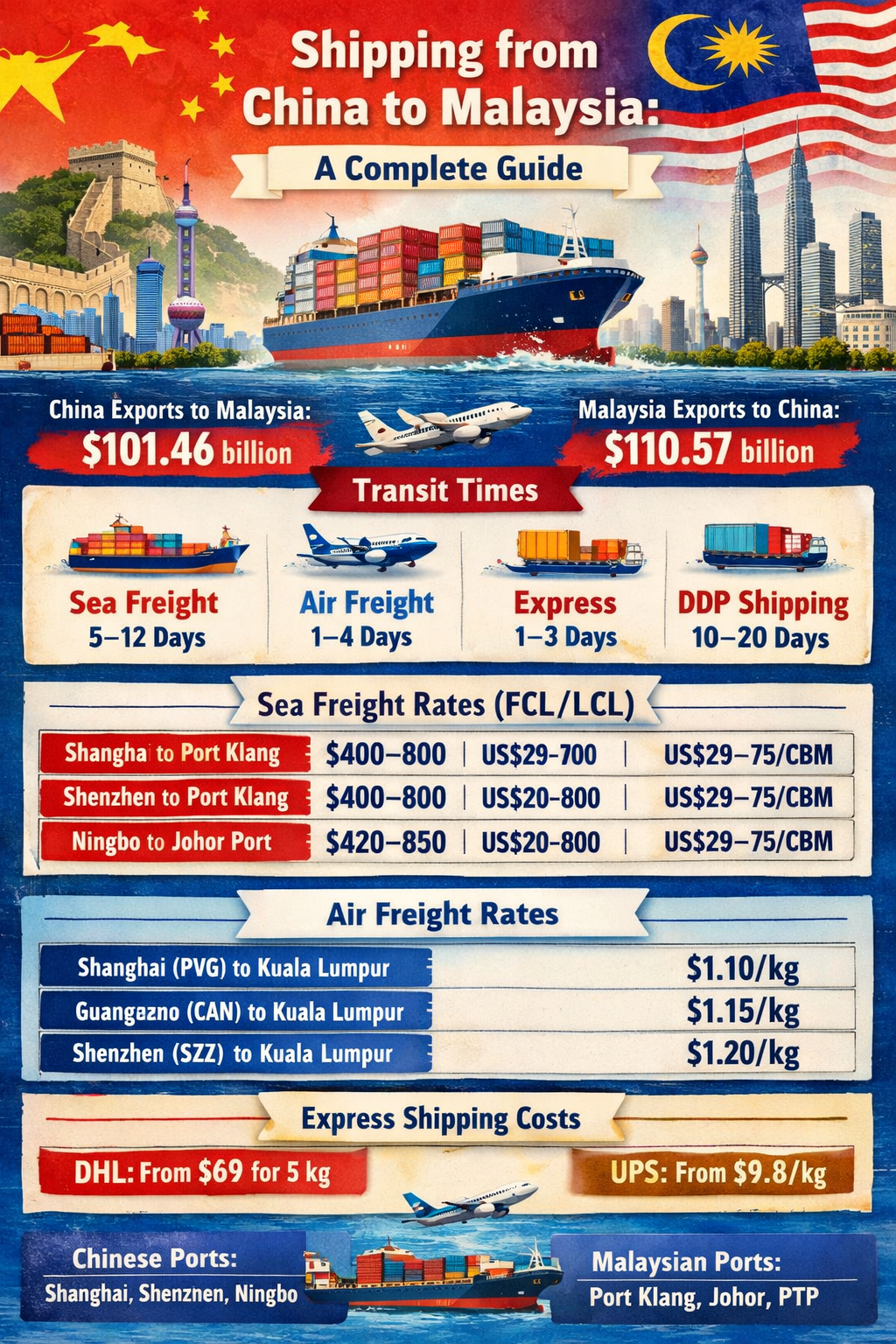
China and Malaysia move a lot of cargo between them, and the lane stays busy because both sides trade high-value industrial goods. In 2024, bilateral trade reached US$212.03 billion, with China exporting US$101.46 billion to Malaysia and importing US$110.57 billion from Malaysia. Malaysia’s official trade data also shows that China remained Malaysia’s largest trading partner for the 16th consecutive year.
That matters for shippers because the China–Malaysia route is mature, flexible, and competitive. The lane is heavily used for electronics, machinery, integrated circuits, telephones, computers, crude petroleum, palm oil, plastics, and other manufacturing inputs and finished goods.
China–Malaysia trade volume and import/export overview
Malaysia’s 2024 external trade reached RM2.879 trillion, while exports rose to RM1.508 trillion and imports climbed to RM1.371 trillion. In that same year, China stayed Malaysia’s top trading partner.
The structure of trade is easy to understand. China sends Malaysia a large volume of electronics-related goods such as integrated circuits, telephones, and computers, while Malaysia sends China crude petroleum, integrated circuits, petroleum gas, and other industrial goods. In practice, this means the lane carries both high-value air cargo and cost-sensitive sea freight.
Transit time by shipping method
| Shipping method | Typical transit time | Best for | Notes |
|---|---|---|---|
| Sea freight | 5–12 days port-to-port on many lanes; 8–15 days is common for mixed routes | Bulk cargo, pallets, and cost-sensitive shipments | Port congestion, transshipment, and customs can add time. |
| Air freight | 1–2 days airport-to-airport on major lanes; 2–4 days is a practical planning range | Urgent, light, or high-value cargo | Airport choice and customs speed matter. |
| International express | 1–3 business days | Samples, documents, small parcels | DHL states most major-city lanes arrive in 1–3 days. (DHL) |
| DDP sea freight | 10–18 days, sometimes 15–20 days door to door | Importers who want tax-included delivery | The quote normally includes duty/tax handling. |
| DDP air freight | 4–7 days, sometimes 2–5 days on fast lanes | Faster door-to-door delivery | Useful when the buyer wants a landed-cost quote. |
Transit time changes with route density, holiday peaks, customs checks, weather, and whether cargo needs consolidation or transshipment. That is why a “fast” lane can still slow down if space tightens at the origin port or if Malaysian customs inspects the shipment.
Sea freight from China to Malaysia
Sea freight is usually the cheapest choice for larger cargo. ABL Logistics notes that sea freight is the lowest-cost mode for this lane, while Vipu Logistics and other market guides show that pricing shifts by route, season, and container type.
Sea freight rates (FCL / LCL)
These are indicative market ranges, not live quotes.
| Route example | FCL 20GP | FCL 40HQ / 40GP | LCL | |
|---|---|---|---|---|
| Shanghai → Port Klang | US$400–800 | US$1,050–1,800 | US$29–75/CBM | |
| Shenzhen → Port Klang | US$400–800 | US$1,050–1,800 | US$29–75/CBM | |
| Guangzhou → Port Klang | US$400–800 | US$1,150–1,800 | US$26–80/CBM | |
| Ningbo → Pasir Gudang / Johor | US$420–850 | US$1,050–1,800 | US$35–75/CBM | |
| Qingdao → Tanjung Pelepas | US$420–850 | US$1,050–1,800 | US$21–75/CBM |
A simple way to interpret the table is this: FCL becomes attractive once cargo volume is large enough to justify a full container, while LCL works better for smaller shipments that do not justify paying for a full box.
Sea transit time and what affects it
For most China–Malaysia sea shipments, plan for roughly 5–12 days on the water and a bit longer if your cargo needs consolidation, transshipment, or inland delivery on both sides. Sea DDP usually adds more handling because the forwarder manages customs, duties, and final-mile delivery.
The main delay factors are port congestion, vessel schedule changes, customs review, weather, and peak-season pressure. April 2026 market notes also show Port Klang congestion and tight equipment supply, which is exactly the kind of issue that pushes up both transit time and price.
Main container ports in China and Malaysia
Main container ports in China
China’s biggest container gateways on this lane usually include Shanghai, Ningbo-Zhoushan, Shenzhen, Qingdao, Guangzhou, Tianjin, and other Pearl River / Yangtze Delta ports. The World Shipping Council’s 2024 ranking shows Shanghai at 51.51 million TEU, Ningbo-Zhoushan at 39.31 million TEU, Shenzhen at 33.38 million TEU, Qingdao at 30.72 million TEU, Guangzhou at 24.75 million TEU, and Tianjin at 21.83 million TEU.
Main container ports in Malaysia
Malaysia’s key container gateways are Port Klang, Port of Tanjung Pelepas (PTP), Penang Port, and Johor Port. Port Klang Authority describes Port Klang as Malaysia’s premier maritime gateway, PTP says it is Malaysia’s advanced container terminal with 14 berths and capacity of up to 12.5 million TEU annually, Penang Port highlights NBCT as its core container hub, and Johor Port states its container terminal capacity is 1.45 million TEU.
Sea freight process
A normal sea shipment follows this flow: booking, cargo pickup or factory delivery, export declaration, port handover, vessel loading, ocean transit, arrival notice, import customs clearance, duty/tax settlement, and final trucking. ApexLink and DHL both emphasize that accurate documents, customs preparation, and shipment visibility are essential for a smooth move.
Representative sea freight case study
Representative case, anonymized
Shipper: furniture factory in Foshan, China
Consignee: wholesaler in Klang Valley, Malaysia
Cargo: 1 × 40HQ, flat-pack furniture, mixed cartons
Route: Guangzhou → Port Klang → final trucking to Shah Alam
Shipping type: FCL sea freight
Typical timeline: factory pickup in 1 day, export clearance in 1 day, sea transit in 6–8 days, import clearance and delivery in 2–3 days
Total: about 10–13 days end to end
In this type of shipment, the cargo is loaded once, sealed once, and delivered in one container. That reduces handling risk and usually gives the best cost per cubic meter when the volume is high enough. This example is a practical model, not a real customer disclosure.
Air Freight | Shipping from China to Malaysia
Air freight fits urgent, valuable, or compact cargo. On this lane, it is common to use Shanghai PVG, Guangzhou CAN, Shenzhen SZX, Beijing PEK, and Hong Kong HKG on the China side, with Kuala Lumpur (KUL) as the most common Malaysia gateway, plus Penang (PEN), Johor Bahru/Senai (JHB), and Kota Kinabalu (BKI) for regional delivery.
Air freight rates
| Shanghai (PVG) → Kuala Lumpur (KUL) | 100–499 kg | US$1.10/kg |
| Shanghai (PVG) → Kuala Lumpur (KUL) | 500–999 kg | US$1.05/kg |
| Shanghai (PVG) → Kuala Lumpur (KUL) | 1,000 kg+ | US$0.95/kg |
| Guangzhou (CAN) → Kuala Lumpur (KUL) | 100–499 kg | US$1.15/kg |
| Guangzhou (CAN) → Kuala Lumpur (KUL) | 500–999 kg | US$1.10/kg |
| Guangzhou (CAN) → Kuala Lumpur (KUL) | 1,000 kg+ | US$1.00/kg |
| Shenzhen (SZX) → Kuala Lumpur (KUL) | 100–499 kg | US$1.20/kg |
| Shenzhen (SZX) → Kuala Lumpur (KUL) | 500–999 kg | US$1.15/kg |
| Shenzhen (SZX) → Kuala Lumpur (KUL) | 1,000 kg+ | US$1.05/kg |
Air transit time and what affects it
Air freight from China to Malaysia usually lands in 1–2 days airport-to-airport on major lanes, while total handling and delivery often takes 2–4 days. ABL lists 1–2 days for air freight, and other freight guides put the practical market range at 3–5 days for standard air shipments.
The biggest delays usually come from customs review, cutoff times, flight schedule gaps, and whether the cargo needs special screening or consolidation. DHL also notes that origin and destination city pairs matter, with major-city shipments moving faster than shipments going to remote areas.
Main international airports in China and Malaysia
China's gateways are commonly used for Malaysian cargo
The lane is commonly served from Shanghai PVG, Guangzhou CAN, Shenzhen SZX, Beijing PEK, and Hong Kong HKG, with ABL’s route table also showing Penang and Kuala Lumpur as regular Malaysia destinations.
Malaysia’s international airports
Malaysia’s Ministry of Transport lists these international airports: Kuala Lumpur International Airport (KLIA), Langkawi, Kuching, Penang, Kota Kinabalu, and Senai International Airport.
Air freight process
The air freight process is usually faster than sea freight, but the documentation needs to be tighter. A normal flow is: booking, cargo pickup, export declaration, airline handover, flight departure, arrival, import clearance, tax payment, and final delivery. DHL’s import guidance for China–Malaysia also lists typical commercial documents such as the invoice, airway bill, business registration, tax ID, and import declaration.
Representative air freight case study
Shipper: electronics supplier in Shenzhen
Consignee: distributor in Kuala Lumpur
Cargo: 220 kg of tablet accessories, carton-packed
Route: Shenzhen SZX → Kuala Lumpur KUL
Shipping type: standard air freight
Typical timeline: pickup and export processing in 1 day, flight within 1 day, customs and delivery in 1–2 days
Total: about 3–4 days end to end
This works well when the buyer needs stock quickly, the item has a higher value per kilogram, and the seller wants to reduce inventory risk instead of chasing the lowest freight rate. That is a common air-freight tradeoff on this lane.
International express from China to Malaysia
Express shipping is the fastest option for parcels, samples, and urgent e-commerce orders. DHL says China-to-Malaysia packages usually arrive in 1–3 days, with most major cities reached in 1–2 days. UPS also publishes Malaysia rate guides and states that its express freight services can deliver in 1–3 business days on applicable routes.
Express rates
| Carrier | Example price | Typical use case | |
|---|---|---|---|
| DHL Express | About US$69–79 for a 5 kg package | Samples, documents, small parcels | |
| DHL Express | About US$17.6/kg in one 55 kg shipment example | Small-to-medium parcel benchmarking | |
| UPS Express | About US$9.8/kg in one 55 kg shipment example | Weight-based express comparison |
Express pricing moves quickly because it depends on volumetric weight, surcharges, fuel, destination, and pickup area. For that reason, the best practice is to treat public prices as a planning guide and request a live quote before booking. DHL and UPS both point users to their online calculators and service guides for final pricing.
Express process
The process is simple: book pickup, prepare invoice and packing list, hand over the parcel, clear export, fly, clear import, and deliver to the consignee. The main advantage is speed; the main drawback is cost per kilogram.
Representative express case study
Shipper: sample room in Guangzhou
Consignee: buyer in Penang
Cargo: 12 kg of fabric samples
Shipping type: DHL Express
Typical timeline: pickup the same day, delivery in 1–2 days
Outcome: fast sample approval without waiting for a freight consolidation cycle
DDU Shipping | Shipping from China to Malaysia
DDP is useful when the buyer wants a landed-cost quote and does not want to handle customs work directly. ABL offers both sea-to-door (DDP) and air-to-door (DDP) services for Malaysia.
DDP options you can choose
You can usually choose sea DDP for lower-cost door delivery or air DDP for faster door delivery. In practice, the forwarder handles customs, duties, taxes, and delivery to the final address.
DDP rates
| DDP method | Indicative price | Typical transit time | Best for |
|---|---|---|---|
| Sea DDP | US$100–150/CBM | 10–18 days | Door-to-door economy shipping |
| Air DDP | US$3–3.8/kg | 4–7 days | Faster landed-cost delivery |
Door-to-door time ranges are slightly broader, which is normal because DDP includes customs and final delivery. In a real shipment, the final timing often depends more on clearance speed than on the flight or vessel itself
DDP transit time and what affects it
DDP timing is affected by customs inspection, product category, duty calculation, address location, and whether the shipment is sent to West Malaysia or East Malaysia. If the cargo is sensitive, battery-powered, or paperwork-heavy, the door-to-door clock usually gets longer.
DDP process
A standard DDP flow looks like this: quotation, pickup, export clearance, international transport, import declaration, duty/tax payment by the forwarder, local delivery, and proof of delivery. The main appeal is simplicity, especially for first-time importers.
Representative DDP case study
Buyer: online seller in Kuala Lumpur
Seller: factory in Yiwu
Cargo: 1.8 CBM household goods
Shipping type: sea DDP
Typical timeline: 12–16 days from pickup to delivery
Experience: the buyer receives one all-in landed-cost quote, so the goods arrive without separate customs handling on the buyer side
Important details for Chinese exporters
First, classify the product correctly. Ordinary goods, sensitive goods, and battery cargo do not move through the system in the same way, and special items can trigger extra screening or documentation. Second, check for anti-dumping or product-specific restrictions before you ship. Third, confirm the final freight quote before handover because prices change quickly in both the sea and air markets.
It also helps to confirm whether your supplier can handle export paperwork. ABL’s service list includes customs clearance, purchasing support, repacking, and inspection, which is one reason many exporters work through a freight forwarder instead of trying to manage every step alone.
Important details for Malaysian importers
Malaysia applies import duty based on HS code, and the rate can vary widely. The U.S. Trade Representative’s country guide notes that Malaysia’s tariffs are often low on average for industrial goods, while DHL’s Malaysia guide says import duty can range from 0% to 60% depending on classification. Malaysia also applies Sales Tax as a single-stage tax on imported and locally manufactured goods.
For low-value goods, Malaysia’s Ministry of Finance says goods worth RM500 or less imported by land, sea, or air are subject to 10% sales tax starting 1 January 2024. That rule matters a lot for e-commerce and small parcel imports.
Delays can happen when customs reviews the shipment, asks for extra documents, or stops a parcel for physical inspection. Port congestion can also push back sea shipments, especially during busy seasons. Because of that, it is smarter to build a buffer into both delivery and launch schedules.
FAQ: Shipping from China to Malaysia
1. How long does shipping from China to Malaysia take?
2. What is the cheapest way to ship to Malaysia?
3. What is the fastest shipping option?
4.Which ports and airports are used most often?
5. Do I need DDP shipping?
6.How do I avoid customs delays?
Shipping from China to Malaysia is efficient when you match the right transport mode to the cargo, prepare the paperwork properly, and plan for Singapore’s import rules in advance. Sea freight works best for cost-sensitive cargo, air freight is ideal for urgent shipments, express is convenient for parcels, and DDU can help simplify door-to-door delivery when the buyer is comfortable handling import charges at destination.
ApexLink's shipping solutions from China to Malaysia
-
Sea Freight (FCL/LCL)/Air Freight/Express
-
Flexible Door-to-Door (DDP/DDU) Services
-
Simple and Efficient Customs Clearance
-
24/7 Professional Support and Fast Response