
SHIPPING FROM CHINA: CUSTOMS CLEARANCE GUIDE (2026)
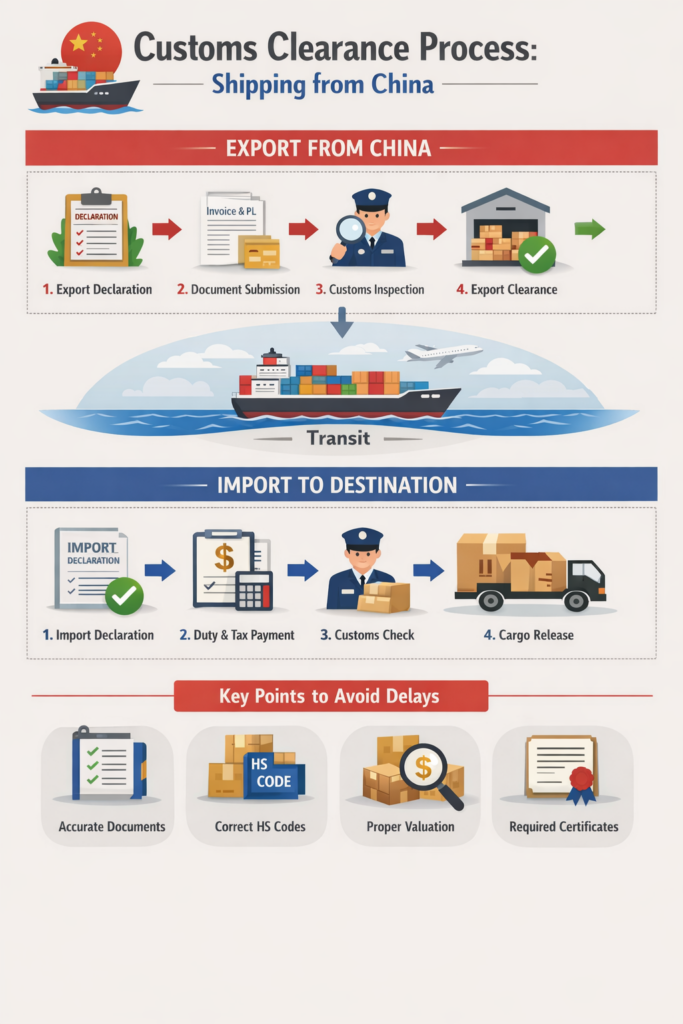
Customs clearance is one of the most critical steps when shipping goods from China. While many importers focus on freight costs and transit time, delays often happen at customs due to incomplete documentation, incorrect declarations, or regulatory issues.
In this guide, we explain how customs clearance works for shipments from China, what documents you need, and how to avoid costly delays. At the same time, we share practical insights based on real shipping cases.
What Is Customs Clearance in International Shipping?
Customs clearance refers to the process of declaring goods to authorities when they enter or leave a country. Authorities review shipment details, assess duties and taxes, and ensure compliance with local regulations.
In most cases, customs clearance involves three key steps:
Submission of shipping documents
Inspection or risk assessment
Payment of duties and release of cargo
Although the process sounds straightforward, it often becomes complex because each country applies different rules. Therefore, working with an experienced freight forwarder can significantly reduce risks.
Key Documents Required for Shipping from China
To ensure smooth customs clearance, you must prepare accurate and consistent documentation. Even small discrepancies can trigger inspections or delays.
The main documents include:
Commercial Invoice (must match actual transaction value)
Packing List (detailed cargo breakdown)
Bill of Lading (or Air Waybill)
HS Code classification
Certificate of Origin (if required)
MSDS and UN38.3 (for lithium batteries or DG cargo)
For example, when exporting furniture from China to the United States, customs authorities may verify the declared value against market benchmarks. If the value appears unusually low, they may request additional proof or reassess duties.
Export Customs Clearance in China
Before goods leave China, exporters must complete an export customs declaration.
Typically, the process includes:
Submit export declaration through the China Customs system.
Provide invoice, packing list, and export license (if applicable)
Undergo inspection if selected.
Obtain customs release for loading.
In practice, delays often occur when exporters use incorrect HS codes or fail to provide required licenses. Therefore, early document verification is essential.
Import Customs Clearance at Destination
Once the shipment arrives, import customs clearance begins.
Although procedures vary by country, the process usually involves:
Filing import declaration
Paying duties and VAT/GST
Customs inspection (if required)
Cargo release
For instance, in Saudi Arabia, importers must register with customs authorities and provide SASO-related compliance documents for certain goods. Without these, clearance may be delayed or rejected.
Common Customs Clearance Issues (And How to Avoid Them)
Even experienced importers encounter customs issues. However, most problems can be prevented with proper preparation.
1. Incorrect HS Code Classification
Misclassification leads to wrong duty rates or penalties. To avoid this, you should confirm HS codes in advance, especially for complex products.
2. Undervaluation Risks
Declaring a lower value may reduce duties temporarily, but customs authorities often cross-check data. As a result, they may impose fines or revalue the shipment.
3. Missing Certifications
Some products require specific certifications (e.g., electronics, medical devices). Without them, customs will hold the cargo.
4. Inconsistent Documents
If the invoice, packing list, and bill of lading do not match, clearance delays are almost inevitable.
Advanced Insights: What Most Importers Overlook
Many shippers focus only on basic documents. However, several less obvious factors can affect customs clearance:
1. Pre-Arrival Clearance (PAC)
In some countries, importers can submit documents before cargo arrival. This approach significantly reduces clearance time and port storage costs.
2. Customs Risk Channels (Green / Yellow / Red)
Customs systems often assign shipments to different inspection channels. A “Green Channel” shipment clears quickly, while a “Red Channel” requires full inspection. Your company’s compliance history directly affects this classification.
3. Transfer (T1) Procedures in the EU
If goods arrive in one EU country but are cleared in another, a T1 transit procedure is required. Without proper handling, cargo may be blocked at inland borders.
4. DG Cargo Sensitivity
Dangerous goods, such as lithium batteries, receive stricter scrutiny. Even if documents are complete, customs may still conduct additional checks.
How We Support Your Customs Clearance
At Apexlink Shipping, we actively manage customs clearance rather than reacting to problems.
We:
Pre-check all documents before shipment
Advise correct HS codes and declaration strategies
Coordinate with customs brokers in destination countries
Provide DDP solutions where applicable
Monitor clearance status in real time
Because we combine freight and customs expertise, we help reduce delays and unexpected costs.
FAQ – Shipping from China: Customs Clearance
1. How long does customs clearance take?
Customs clearance usually takes 1–3 days. However, inspections or missing documents can extend this timeline.
2. Can I handle customs clearance myself?
Yes, but in most cases, importers appoint a licensed customs broker to avoid compliance risks.
3. What happens if customs holds my shipment?
Customs may request additional documents, inspect cargo, or reassess duties. You must respond quickly to avoid storage charges.
4. Do all shipments get inspected?
No. Customs uses a risk-based system. Shipments with consistent records are less likely to be inspected.
5. Is DDP shipping a good option?
DDP simplifies the process because the freight forwarder handles customs clearance and duties. However, it may cost more and require careful compliance checks.
Optimize Your Shipping from China Today
Customs clearance does not have to be complicated. When you prepare documents correctly and plan ahead, you can avoid delays and reduce costs.
If you are shipping from China and need reliable customs support, our team is ready to help you manage the entire process—from export declaration to final delivery.