
BULK RORO SHIPPING FROM CHINA: EFFICIENT TRANSPORT FOR VEHICLES AND HEAVY CARGO
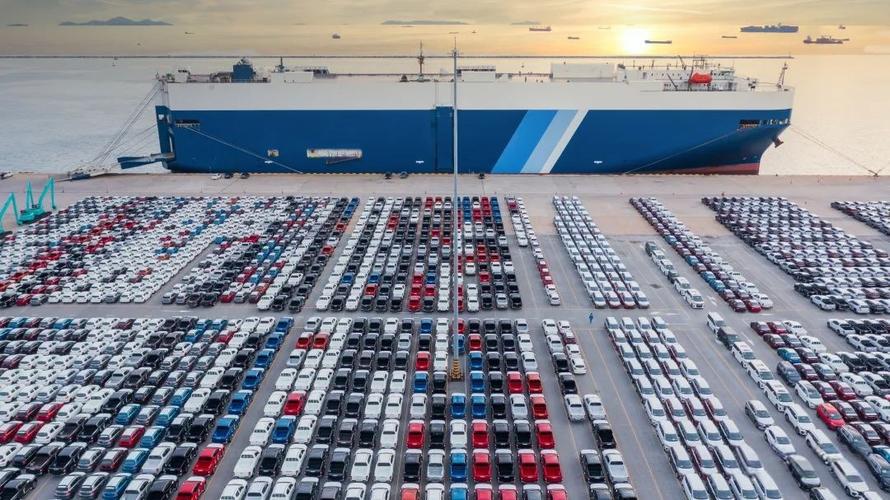
Bulk RoRo shipping offers a practical solution for transporting vehicles, heavy machinery, and oversized cargo across international routes. Unlike container shipping, Roll-on Roll-off (RoRo) vessels allow cargo to be driven or towed directly onto the ship using built-in ramps. As a result, the loading process becomes faster and more efficient.
Because the cargo rolls on and rolls off the vessel, the handling process is significantly simplified. In addition, fewer lifting operations reduce the risk of damage during loading and unloading. Therefore, many industries rely on bulk RoRo shipping when they need to move large equipment or vehicles safely and efficiently.
What Is Bulk RoRo Shipping?🚢🚗
Bulk RoRo shipping refers to transporting large volumes of wheeled or movable cargo using RoRo vessels. These ships feature internal decks and ramps that allow vehicles, trucks, trailers, and heavy equipment to drive directly onto the vessel.
However, not all cargo needs to be self-driven. Logistics operators can place static cargo on specialized platforms such as MAFI trailers, which are then towed onto the ship. As a result, RoRo vessels can carry both self-propelled vehicles and oversized industrial equipment.
Typical RoRo cargo includes:
Passenger vehicles and commercial trucks
Construction machinery
Agricultural equipment
Trailers and buses
Industrial project cargo
Oversized or out-of-gauge cargo
Because RoRo vessels offer flexible deck configurations and strong load capacity, they can accommodate cargo that exceeds standard container dimensions.
Key Advantages of Bulk RoRo Shipping
Faster Loading and Unloading
RoRo vessels use ramps instead of cranes. Consequently, operators can drive cargo directly onto the ship. This process significantly reduces port handling time and speeds up vessel turnaround.
As a result, shipments move through ports more quickly, which helps improve delivery schedules.
Reduced Cargo Handling Risk
Traditional shipping often requires multiple lifting operations. However, RoRo cargo stays on its wheels or transport platform during loading and unloading.
Because of this simplified handling process, the risk of impact damage becomes much lower. In addition, cargo remains securely lashed to deck anchor points throughout the voyage.
Cost-Effective for Large Cargo
Bulk RoRo shipping eliminates several container-related expenses. For example, shippers do not need container stuffing, container rental, or heavy crane operations.
Therefore, RoRo shipping often provides a more economical solution for transporting large vehicles and machinery across international routes.
In particular, companies that export heavy equipment or fleet vehicles can significantly reduce logistics costs.
Ideal for Oversized and Project Cargo
Many types of industrial equipment simply do not fit into standard containers. Fortunately, RoRo vessels feature wide decks, high load capacity, and adjustable deck heights.
Because of this design, they can accommodate oversized cargo such as:
Excavators
Mining equipment
Large generators
Industrial vehicles
As a result, RoRo shipping plays a critical role in global project logistics.
Bulk RoRo Shipping from China
China exports large quantities of vehicles and machinery every year. Therefore, RoRo shipping routes from China connect major manufacturing regions to global markets.
Typical export ports include:
Shanghai
Tianjin
Guangzhou
Qingdao
From these ports, RoRo vessels serve destinations in:
Europe
the Middle East
Africa
South America
Southeast Asia
Because many vessels operate on fixed schedules, RoRo shipping also provides predictable transit times for international supply chains.
Why Choose a Professional RoRo Freight Forwarder?
Although RoRo shipping is efficient, it still requires careful planning. A professional freight forwarder helps manage the entire process, including:
Cargo booking and vessel space allocation
Export documentation
Port handling coordination
Customs clearance support
Inland transportation arrangements
As a result, businesses can move vehicles and heavy equipment internationally with fewer delays and lower risk.
Understanding MAFI Trailers in RoRo Transport
In bulk RoRo shipping, not all cargo can move on its own wheels. Therefore, logistics operators often use MAFI trailers to transport static cargo.
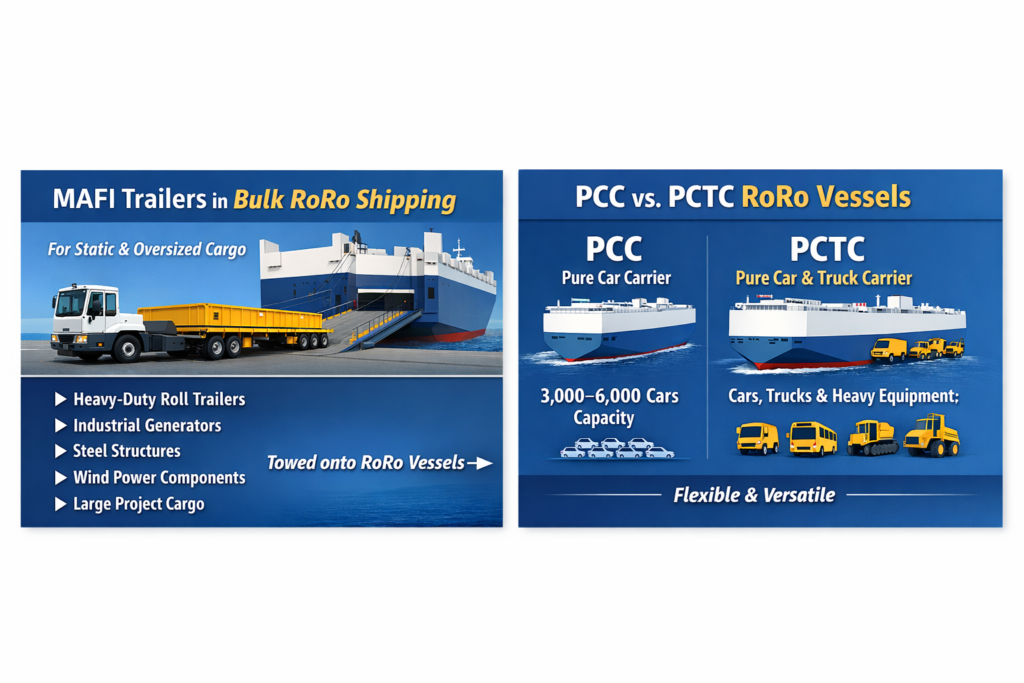
A MAFI trailer is a heavy-duty roll trailer designed specifically for RoRo vessels. It features a flat platform and strong axle support, which allows it to carry extremely heavy loads.
For example, freight forwarders frequently load the following cargo onto MAFI trailers:
Industrial generators
Steel structures
Large transformers
Wind power components
Oversized project cargo
Once the cargo is secured on the trailer, terminal tractors tow the trailer directly onto the RoRo vessel through the ramp. As a result, even non-wheeled cargo can move through the RoRo system efficiently.
Because of this flexibility, MAFI trailers play a critical role in modern RoRo logistics operations.
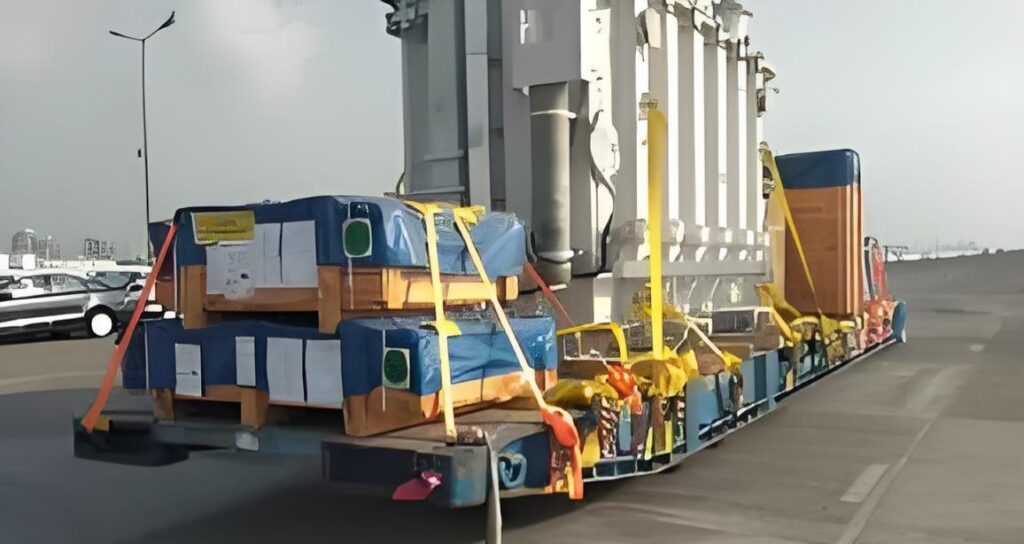
Lashing and Securing Cargo on RoRo Vessels
Cargo securing is one of the most important safety procedures in bulk RoRo shipping. During ocean transport, vessels experience rolling, pitching, and vibration. Therefore, operators must secure every cargo unit properly before departure.
Port workers usually follow a standard lashing procedure:
Position the cargo on the deck or trailer
Attach lashing chains or straps to the vessel’s deck points
Tighten the lashing system using tensioners
Inspect the cargo stability before sailing
Because RoRo vessels contain hundreds or even thousands of vehicles, proper lashing ensures cargo stability throughout the voyage. In addition, shipping lines follow strict international maritime safety regulations when securing cargo.
As a result, well-secured cargo significantly reduces damage risks during long ocean voyages.
Stowage Planning on RoRo Ships
Stowage planning determines how cargo is arranged inside the vessel. This process is extremely important because RoRo ships operate with multiple internal decks.
First, planners evaluate the weight distribution of the cargo. Heavy equipment usually goes on lower decks to maintain vessel stability.
Next, planners consider cargo dimensions. High or oversized cargo often requires decks with adjustable height.
Finally, they optimize the loading sequence. Cargo that will unload at earlier ports is positioned near the ramp or exit route.
Because RoRo vessels operate on multi-port routes, proper stowage planning improves both safety and unloading efficiency.
Difference Between Pure Car Carriers (PCC) and Pure Car and Truck Carriers (PCTC)
Two common vessel types operate in the RoRo shipping industry: PCC and PCTC ships.
Pure Car Carrier (PCC)
PCC vessels mainly transport passenger vehicles. These ships usually feature multiple decks designed specifically for cars. As a result, they maximize vehicle loading capacity.
Typical PCC capacity ranges from 3,000 to 6,000 cars per voyage.
Pure Car and Truck Carrier (PCTC)
PCTC vessels offer greater flexibility. In addition to passenger cars, they can transport:
Trucks
Buses
Construction equipment
Agricultural machinery
Because these ships include adjustable deck heights, they can accommodate taller cargo. Therefore, PCTC vessels dominate modern RoRo shipping routes.
Some of the largest PCTC vessels today can carry over 7,000 vehicles in a single shipment.
Port Terminal Operations in RoRo Shipping
RoRo terminals operate differently from traditional container terminals. Instead of cranes, these terminals rely on specialized vehicle handling equipment.
A typical RoRo terminal includes:
Vehicle marshalling yards
Pre-delivery inspection areas
RoRo ramps and loading lanes
Heavy cargo staging zones
During loading operations, terminal drivers move vehicles in a continuous flow from the yard to the vessel ramp. Because this process resembles a large parking operation, it allows ports to load thousands of vehicles within a short time.
Consequently, RoRo terminals often achieve faster turnaround times compared with traditional cargo operations.
FAQ – Bulk RoRo Shipping From China
What does RoRo shipping mean?
RoRo stands for Roll-on Roll-off shipping. It describes a shipping method where cargo is driven or towed directly onto a vessel using ramps and then driven off at the destination port.
What types of cargo can be shipped by RoRo?
RoRo shipping is suitable for cargo that can roll, drive, or be placed on wheeled platforms. Common cargo includes:
Cars and trucks
Buses and trailers
Construction equipment
Agricultural machinery
Heavy project cargo
Is RoRo cheaper than container shipping?
In many cases, yes. RoRo shipping eliminates container loading, container rental, and heavy crane operations. Therefore, it can reduce overall transportation costs for vehicles and oversized cargo.
When should I choose bulk RoRo shipping?
You should consider RoRo shipping when:
Cargo is wheeled or towable
Equipment exceeds container dimensions
Vehicles are exported in large quantities
Fast loading and unloading are required
How long does RoRo shipping take?
Transit time depends on the route and shipping schedule. Most RoRo vessels operate on fixed services between major global ports, which allows relatively predictable transit times.
What is a MAFI trailer in RoRo shipping?
A MAFI trailer is a specialized heavy platform used to transport static or oversized cargo on RoRo vessels. Terminal tractors tow these trailers onto the ship via the ramp.
How is cargo secured on a RoRo vessel?
Workers secure cargo using lashing chains, straps, and deck anchor points. They tighten these systems to prevent movement caused by ocean motion during the voyage.
Can oversized cargo be shipped by RoRo?
Yes. If the cargo cannot move on its own wheels, operators place it on MAFI trailers or roll trailers and tow it onto the vessel.
RoRo has become the backbone of global automotive and machinery exports, with Chinese ports playing an increasingly important role in the worldwide RoRo logistics network.