
SHIPPING FROM CHINA: SPECIALIZED CONTAINERS
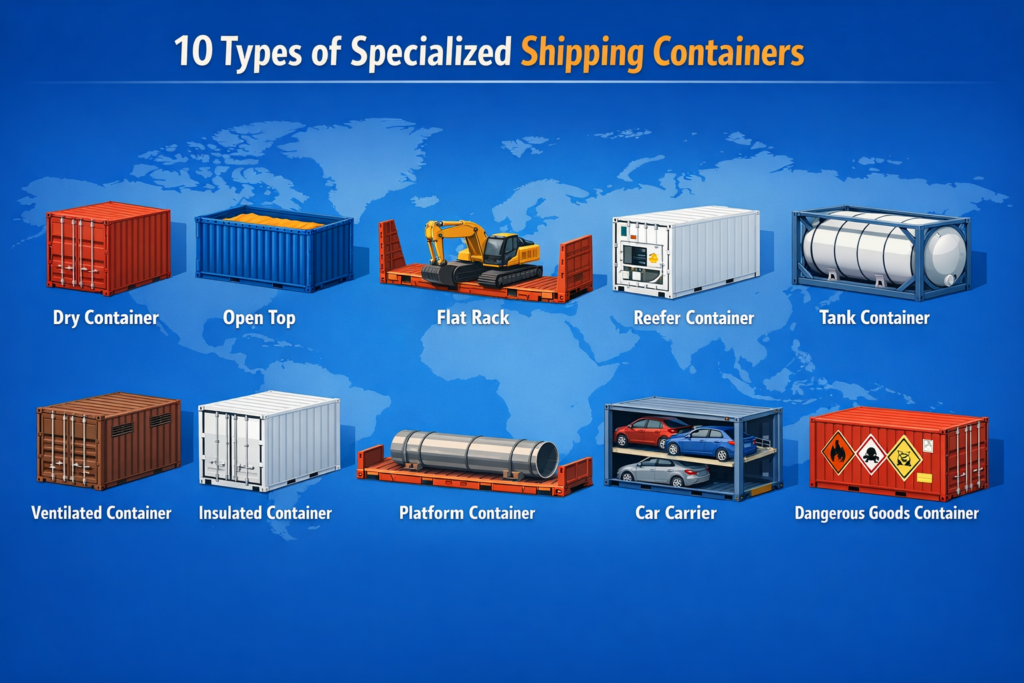
Standard containers handle most cargo. However, some shipments require special equipment because of their size, weight, temperature, or physical characteristics. In these cases, specialized containers provide a safer and more efficient transport solution.
Specialized containers allow shippers to move oversized cargo, temperature-controlled goods, liquids, vehicles, and project cargo across global shipping routes. As a result, freight forwarders can deliver complex shipments while maintaining cargo safety and regulatory compliance.
At Apexlink Shipping, we help customers choose the right container type according to cargo specifications, handling requirements, and international shipping regulations.
Common Types of Specialized Containers
Open Top Containers (OT)
Open-top containers are designed for cargo that cannot be loaded through standard container doors. Instead of a fixed roof, they use a removable tarpaulin cover, which allows cranes to load cargo from the top.
Therefore, they work well for tall or heavy equipment that exceeds standard container height limits.
Typical cargo includes:
Industrial machinery
Construction equipment
Steel pipes and large components
Timber and oversized equipment
In addition, open-top containers simplify loading operations because cranes can place cargo directly into the container.
Flat Rack Containers (FR)
Flat rack containers provide one of the most flexible solutions for oversized or irregular cargo. These containers have no roof and no side walls, while strong end walls help secure heavy loads.
Because of this structure, cargo can be loaded from the top, side, or front, which greatly simplifies the handling of large equipment.
Typical cargo includes:
Heavy machinery
Vehicles and boats
Wind turbine components
Construction materials
Meanwhile, carriers often use flat racks for OOG cargo (Out-of-Gauge cargo) in international shipping projects.
Reefer Containers (RF)
Reefer containers maintain a controlled temperature during transport. They include an integrated refrigeration system that keeps cargo within a specified temperature range.
Consequently, reefer containers protect perishable or temperature-sensitive goods throughout the supply chain.
Typical cargo includes:
Frozen meat and seafood
Fruits and vegetables
Pharmaceuticals
Dairy products
In addition, these containers connect to the vessel or terminal power systems to maintain constant temperature during transit.
Tank Containers (ISO Tank)
Tank containers transport liquid or gaseous cargo in bulk. A stainless steel tank sits inside a protective steel frame that matches standard container dimensions.
As a result, tank containers move easily through the global container logistics network.
Typical cargo includes:
Chemicals
Food-grade liquids (wine, milk, edible oils)
Petroleum products
Industrial liquids
Furthermore, tank containers provide high safety standards for transporting hazardous or sensitive liquids.
Ventilated and Insulated Containers
Some cargo requires airflow or insulation instead of refrigeration. For example, commodities such as coffee beans or cocoa need ventilation to prevent moisture buildup during transport.
Similarly, insulated containers protect cargo from extreme temperature changes during long ocean voyages.
Therefore, logistics planners often use these containers for agricultural products and sensitive bulk goods.
Dangerous Goods Containers (DG Containers)
Dangerous goods containers are used to transport hazardous materials that require strict safety control during international shipping. These containers comply with the International Maritime Dangerous Goods (IMDG) Code, which regulates the safe transportation of hazardous cargo by sea.
Unlike standard containers, DG shipments require additional documentation, labeling, and packaging. Therefore, shippers must carefully prepare cargo before loading. In addition, carriers and ports inspect these shipments more strictly to ensure safety during transport.
DG containers can include several container types depending on the nature of the cargo. For example, chemicals may travel in tank containers, while packaged hazardous goods may be loaded inside standard or ventilated containers with proper segregation and safety markings.
Typical dangerous goods transported in containers include:
Industrial chemicals
Flammable liquids and gases
Paints and solvents
Hazardous raw materials
Moreover, dangerous goods containers must display hazard class labels, UN numbers, and warning placards on the container exterior. These markings allow port operators and transport staff to identify potential risks quickly.
At Apexlink Shipping, our logistics specialists handle DG cargo according to international safety regulations. We assist customers with DG declaration, documentation preparation, and compliant container loading procedures. As a result, we ensure hazardous cargo moves safely through global shipping networks.
When Should You Use a Specialized Container?
Choosing the right container type reduces transport risks and improves cargo safety. Generally, you should consider specialized containers when:
Cargo exceeds standard container dimensions
Cargo requires temperature control
Goods are liquid or hazardous
Loading requires crane access from the top or side
Cargo has unusual shapes or heavy weight
At Apexlink Shipping, our team evaluates cargo specifications and recommends the most suitable container equipment.
Advantages of Using Specialized Containers in Global Shipping
Specialized containers play an important role in modern logistics. While standard containers handle most cargo, certain goods require customized transport conditions. Therefore, specialized containers provide a reliable solution for complex shipments.
First, they improve cargo safety. Oversized or delicate cargo often faces higher risks during transport. However, specialized containers secure cargo with reinforced structures, dedicated frames, or controlled environments. As a result, they reduce damage risks during long-distance shipping.
Second, they increase operational efficiency. When cargo fits properly inside the right container type, loading and unloading become faster. For example, cranes can easily load machinery into flat rack containers. Similarly, forklifts can quickly handle goods inside open-top containers. Consequently, logistics teams reduce handling time and avoid unnecessary delays at ports.
In addition, specialized containers support international trade across many industries. Manufacturers, construction companies, energy suppliers, and food exporters all rely on these containers to move their cargo globally. Without specialized containers, transporting large industrial equipment or temperature-sensitive products would be extremely difficult.
Specialized vs Standard Containers
| Aspect | Specialized Containers | Standard Containers |
|---|---|---|
| Cargo | Special shapes, high-risk, or temperature-controlled goods | Dry, standard-sized goods |
| Cost | Higher (special equipment, securing, insurance) | Lower |
| Transit Time | Longer (custom handling) | Stable, predictable |
| Complexity | High (requires expertise) | Low |
Industries That Frequently Use Specialized Containers
Many industries depend on specialized containers to move their goods safely across continents. Each industry has unique transportation challenges, and specialized equipment helps overcome them.
Construction and Heavy Machinery
Construction projects often require transporting bulldozers, cranes, steel beams, and other heavy industrial equipment. These items rarely fit inside standard containers. Therefore, logistics providers often use flat rack containers or open top containers to move oversized cargo.
Moreover, project cargo shipments frequently involve multiple transport stages. Equipment may travel by truck to a port, then by ship, and finally by rail or road at the destination. Specialized containers make this multimodal process easier because they follow standardized container dimensions.
Food and Agriculture
Food exporters rely heavily on reefer containers to maintain product quality. Fresh fruits, seafood, dairy products, and frozen foods require strict temperature control during international transport.
Furthermore, consistent refrigeration prevents spoilage and ensures food safety compliance in importing countries. As a result, refrigerated containers have become essential in the global food supply chain.
Chemical and Liquid Transport
Liquid cargo presents different challenges. Many chemicals, oils, and food-grade liquids cannot travel in standard containers. Instead, companies use ISO tank containers to transport these materials safely.
These tanks are designed with durable stainless steel and protective frames. Therefore, they meet international safety standards and allow safe handling at ports and terminals worldwide.
Energy and Industrial Projects
Large energy projects often require transporting wind turbine components, generators, pipelines, and refinery equipment. These items are usually oversized and extremely heavy.
Consequently, logistics providers frequently use flat racks and specialized lifting equipment. Proper container selection helps engineers plan the entire shipping process more efficiently.
Key Considerations When Choosing a Specialized Container
Choosing the correct container type is critical for safe and efficient transport. Several factors influence the decision.
First, cargo dimensions play a major role. If cargo exceeds standard container height or width, logistics planners must select equipment that accommodates those measurements.
Second, cargo weight must be considered carefully. Heavy machinery may require reinforced container structures or special securing methods.
Temperature requirements also influence container selection. Perishable goods require refrigerated containers to maintain consistent conditions throughout the journey.
Finally, handling equipment at ports and warehouses should be evaluated. Some containers require cranes for loading, while others allow forklift access. Therefore, logistics teams must coordinate handling methods in advance.
At Apexlink Shipping, our specialists analyze these factors before recommending the best container solution. This approach helps customers avoid costly mistakes and ensures cargo arrives safely at its destination.
Why Work with an Experienced Freight Forwarder
Shipping specialized cargo requires more planning than standard container shipments. Freight forwarders must coordinate container availability, port handling, documentation, and international regulations.
Experienced logistics providers understand these requirements and manage the entire shipping process. They also work closely with shipping lines, terminals, and transport partners to ensure smooth cargo movement.
Furthermore, professional freight forwarders help customers reduce risks associated with oversized or sensitive cargo. With proper planning and container selection, businesses can move complex shipments across global trade routes with confidence.
FAQ – Specialized Containers in International Shipping
What is a specialized shipping container?
A specialized container is a shipping container designed for cargo that cannot fit in a standard dry container. These containers handle temperature-controlled goods, oversized cargo, liquids, and project shipments.
What cargo requires specialized containers?
Several types of cargo require specialized containers, including:
Heavy machinery
Oversized industrial equipment
Frozen food and pharmaceuticals
Chemicals and bulk liquids
Vehicles and construction materials
Choosing the correct container protects cargo and simplifies loading operations.
Are specialized containers more expensive?
Yes, specialized containers typically cost more than standard containers. However, they reduce cargo damage risk and simplify logistics handling, which often lowers overall project costs.
What is the difference between flat rack and open top containers?
Flat rack containers have no side walls or roof, making them ideal for extremely large cargo. In contrast, open top containers still have side walls but allow top loading with a removable cover.
Therefore, flat racks are used for very large cargo, while open tops work well for tall cargo.
Can specialized containers be used for multimodal transport?
Yes. Most specialized containers follow ISO container standards, so they can move easily between ships, trucks, and trains in global logistics networks.