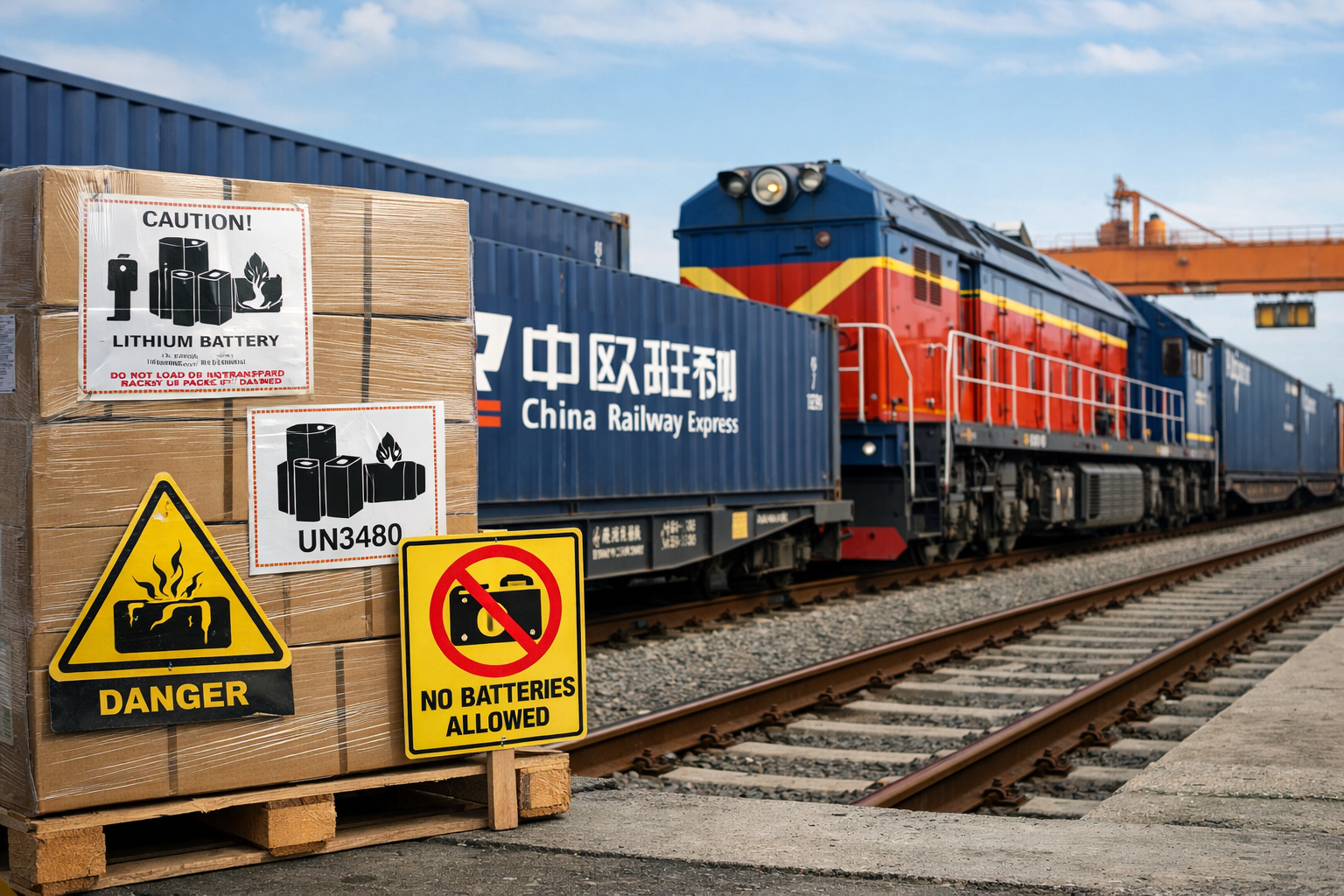
Railway freight plays a vital role in Eurasian trade. In recent years, the China Railway Express has connected China with Europe faster than ocean shipping and at a lower cost than air freight. However, despite its growing popularity, many railway operators completely refuse battery cargo.
Why does railway freight reject batteries so strictly? And why do some stations in China accept small volumes while others refuse them entirely? In this article, we explain the operational realities behind these decisions and share a real-case scenario of battery cargo being rejected and returned.
Railway Freight Has Unique Operational Characteristics
First, railway freight operates under a fixed schedule. Trains cannot simply stop midway to isolate dangerous goods. Unlike vessels that sail across open seas or aircraft that carry smaller, segregated shipments, railway trains transport dozens of containers connected in one long formation.
Because of this structure:
1)One container problem can affect the entire train.
2)Cross-border routes limit emergency response options.
3)Risk control must be extremely strict before departure.
Moreover, many China-Europe rail routes pass through remote areas in Central Asia and Eastern Europe. If a battery fire occurs, local response resources may be limited. Therefore, operators prefer zero tolerance rather than partial risk management.
As a result, railway authorities adopt a highly conservative stance toward batteries.
Batteries Are Classified as Dangerous Goods
Lithium batteries fall under Class 9 dangerous goods according to international transport regulations. Although ocean and air freight can handle them under strict packaging and documentation rules, railway freight follows additional regional controls.
Batteries pose several risks:
Thermal runaway
Short circuit
Hidden internal damage
Delayed ignition during vibration
Rail transport generates continuous vibration over thousands of kilometers. Consequently, even well-packed cargo may experience stress during long-distance transit.
Furthermore, trains often cross multiple customs territories. Each country along the route may apply different dangerous goods rules. If one transit country refuses battery cargo, the entire train must comply.
Therefore, many rail operators decide to reject batteries entirely rather than manage complex compliance across borders.
The Impact of Battery Cargo on an Entire Train
Unlike sea freight, where dangerous goods can be stored in designated deck areas, railway containers sit tightly connected. A fire in one container can spread rapidly.
Additionally:
1. Insurance companies significantly increase railway premiums when operators include dangerous goods.
2. Some transit countries require additional approval procedures.
3. Inspection requirements may delay the train departure.
In practice, railway operators prioritize schedule stability. Even a small battery shipment can cause documentation delays for all containers on board.
From an operational perspective, the risk-reward ratio simply does not justify accepting batteries.
Why Some Chinese Stations Accept Batteries While Others Refuse
Interestingly, not all railway stations apply the same policy.
For example:
Chongqing and Changsha may accept small volumes of compliant battery cargo under strict review.
Xi’an and Wuhan completely refuse battery shipments.
This difference usually depends on:
Local railway bureau policy
Availability of dangerous goods inspection teams
Transit country agreements
Past incident history
Stations like Chongqing developed earlier experience handling mixed cargo under controlled quotas. In contrast, stations such as Xi’an and Wuhan adopted a strict “no battery” policy to maintain operational stability.
However, even at stations that accept batteries, approval is limited, documentation is strict, and rejection remains common.
Real Case: Battery Cargo Rejected and Returned
Last year, a shipper declared “electronic accessories” for rail transport from central China to Europe. During pre-departure inspection, customs discovered lithium batteries inside the cargo.
Although the shipper argued that the batteries were installed in devices, the railway operator requested full UN38.3 reports, MSDS documentation, and dangerous goods declarations. The documents were incomplete.
As a result:
The container was removed from the train.
The shipment was returned to origin.
The shipper paid additional handling and storage fees.
Delivery was delayed by over 20 days.
Eventually, the cargo had to be rerouted by sea freight instead of rail.
This case illustrates a clear lesson: railway freight applies strict pre-control rather than post-risk management.
Why Railway Operators Prefer a “Zero Battery” Policy
Railway freight focuses on stability, speed, and border efficiency. Once a train departs, it must maintain predictable transit time.
Allowing batteries would introduce:
Additional documentation review
Border re-inspection risk
Higher insurance cost
Operational uncertainty
Therefore, many stations adopt a complete refusal policy to protect schedule integrity.
From their perspective, rejecting battery cargo protects hundreds of other shipments on the same train.
FAQ
1. Do railway authorities prohibit all battery shipments by rail?
Not entirely. Some stations allow limited quantities under strict compliance. However, many major hubs refuse them completely.
2. Can railway operators ship products with installed batteries?
It depends on station policy and documentation. Even installed lithium batteries may require UN38.3 test reports and dangerous goods declarations.
3. Why can sea freight carry batteries but rail often cannot?
Ocean vessels have designated dangerous goods storage areas and international frameworks like the IMDG Code. Railway routes cross multiple countries with varying regulations and limited emergency response capacity.
4. Which Chinese railway stations are stricter?
Stations such as Xi’an and Wuhan generally refuse battery cargo. Chongqing and Changsha may accept small approved volumes, but policies can change.
5. What is the safest alternative for battery shipments?
Sea freight remains the most stable solution for large battery shipments. Air freight works for urgent but compliant small shipments.
Final Thoughts
Railway freight offers speed and cost advantages between China and Europe. However, its operational structure leaves little room for hazardous cargo flexibility.
Because one battery incident could disrupt an entire train and cross-border corridor, many operators choose total refusal over controlled acceptance.
Before planning rail transport, shippers should verify station policy in advance. When batteries are involved, proactive route selection can prevent costly rejection and delays.
If you handle battery cargo regularly, build a compliance checklist and consult experienced ApexLink Shipping before booking railway space.