When Will Hainan Officially Launch the Independent Customs Operation?
One of the most frequently asked questions in global trade and logistics circles is when Hainan will formally implement its independent customs operation.
.
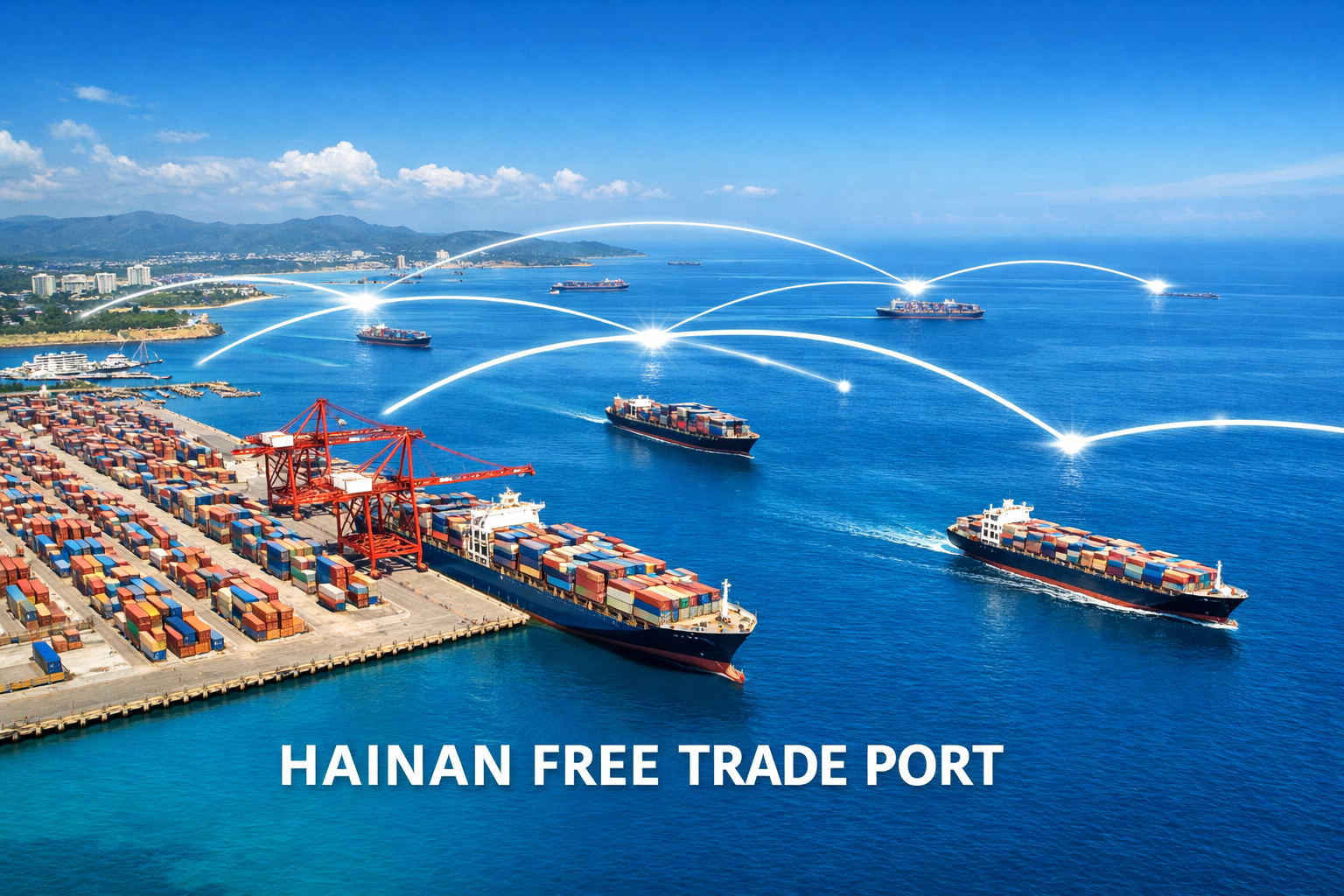
According to official announcements, Hainan Free Trade Port will launch its island-wide independent customs operation on December 18, 2025. This marks the moment when Hainan becomes a customs territory separate from mainland China under the “first line open, second line controlled” framework.
From that point onward, goods entering Hainan from overseas will enjoy simplified customs procedures and broader tariff exemptions, while cargo moving between Hainan and mainland China will be subject to defined customs supervision. As a result, customs clearance efficiency is expected to improve significantly, especially for international trade, shipping, and bonded logistics activities.
More importantly, this date represents not just a policy adjustment but a structural shift in how China integrates with global trade networks.
Hainan’s Trade and Shipping Position Before the Independent Customs Operation
Before the independent customs operation, Hainan already held a unique—but limited—position in China’s trade and maritime landscape.
Traditionally, the island was best known for tourism, duty-free retail, and regional shipping services in the South China Sea. Ports such as Yangpu handled growing volumes of bulk cargo and containers, yet Hainan remained secondary to major hubs like Shanghai, Shenzhen, and Ningbo in terms of international shipping influence.
Although the 2020 Hainan Free Trade Port Master Plan introduced gradual trade facilitation measures, customs procedures were still largely aligned with mainland China. Consequently, tariff advantages and logistics flexibility were restricted, limiting Hainan’s role as a true global trade hub.
In short, Hainan functioned more as a regional gateway than a strategic redistribution center for international shipping and trade.
How Hainan’s Trade and Shipping Role Will Change After Independent Customs Operation
After the independent customs operation takes effect, Hainan’s role in international trade and shipping will change fundamentally.
First, the expansion of zero-tariff policies will allow a much wider range of imported goods to enter Hainan duty-free. This immediately strengthens the island’s competitiveness for processing trade, re-export, and value-added logistics services.
Second, under the island-wide customs framework, Hainan is expected to evolve into a regional shipping and distribution hub connecting China with Southeast Asia, Oceania, and global markets. As shipping lines adjust routes and logistics providers establish bonded warehouses, cargo flows are likely to accelerate.
Finally, for multinational companies, Hainan offers a new supply-chain option: access to the Chinese market combined with offshore-style trade efficiency. This hybrid advantage positions Hainan as a strategic node rather than merely a destination.
In essence, once the independent customs operation takes effect, Hainan will move from a peripheral trade zone to a high-openness Free Trade Port that actively shapes international shipping and logistics networks.
A New Pivot Point for International Trade
As tariffs drop, Hainan quickly becomes a preferred entry and redistribution hub. In this context, global traders no longer face a simple ‘China-or-not’ decision. Instead, Hainan offers a hybrid option—access to China’s vast market while retaining many characteristics of an offshore trade zone.
Meanwhile, value-added activities such as processing, assembly, and re-export become increasingly attractive. As goods enter Hainan duty-free and exit toward Southeast Asia, Oceania, or even back to the mainland, trade flows gain flexibility that traditional ports often struggle to provide.
Shipping Networks Feel the Ripple Effect
Inevitably, shipping routes adjust to policy gravity. As Hainan’s role expands, new regional sea lanes and feeder services begin to emerge. Shipping lines, drawn by growing cargo volumes and policy incentives, gradually increase port calls, while logistics providers establish bonded warehouses and consolidation centers nearby.
At the same time, air cargo and express logistics benefit as well. High-value goods, pharmaceuticals, and temperature-sensitive products find Hainan particularly appealing, thanks to faster clearance and reduced compliance friction. In effect, shipping efficiency becomes not merely a cost advantage, but a strategic one.
Supply Chains Grow More Agile
Beyond ports and vessels, the deeper impact lies in supply chain design. Companies that once relied on single-entry strategies now explore multi-node distribution, using Hainan as a buffer against tariff uncertainty and regulatory risk. As a result, inventory cycles shorten, capital turnover accelerates, and resilience improves.
Moreover, when trade rules are clearer and more predictable, long-term planning becomes easier. That clarity, in turn, encourages multinational manufacturers and traders to anchor more regional operations within the Free Trade Port ecosystem.
Looking Ahead: Opportunity with Strategic Weight
Ultimately, Hainan’s closed customs operation is not an isolated experiment. Rather, it reflects China’s broader intention to integrate more deeply—yet more selectively—into global trade. For international shipping and logistics players, this creates both opportunity and responsibility: opportunity to capture new flows, and responsibility to adapt networks accordingly.
As policies continue to mature, one thing becomes clear: Hainan is no longer just a destination—it is a connector. And in the evolving map of global trade and shipping, connectors often matter most.