
Shipping from China to Singapore
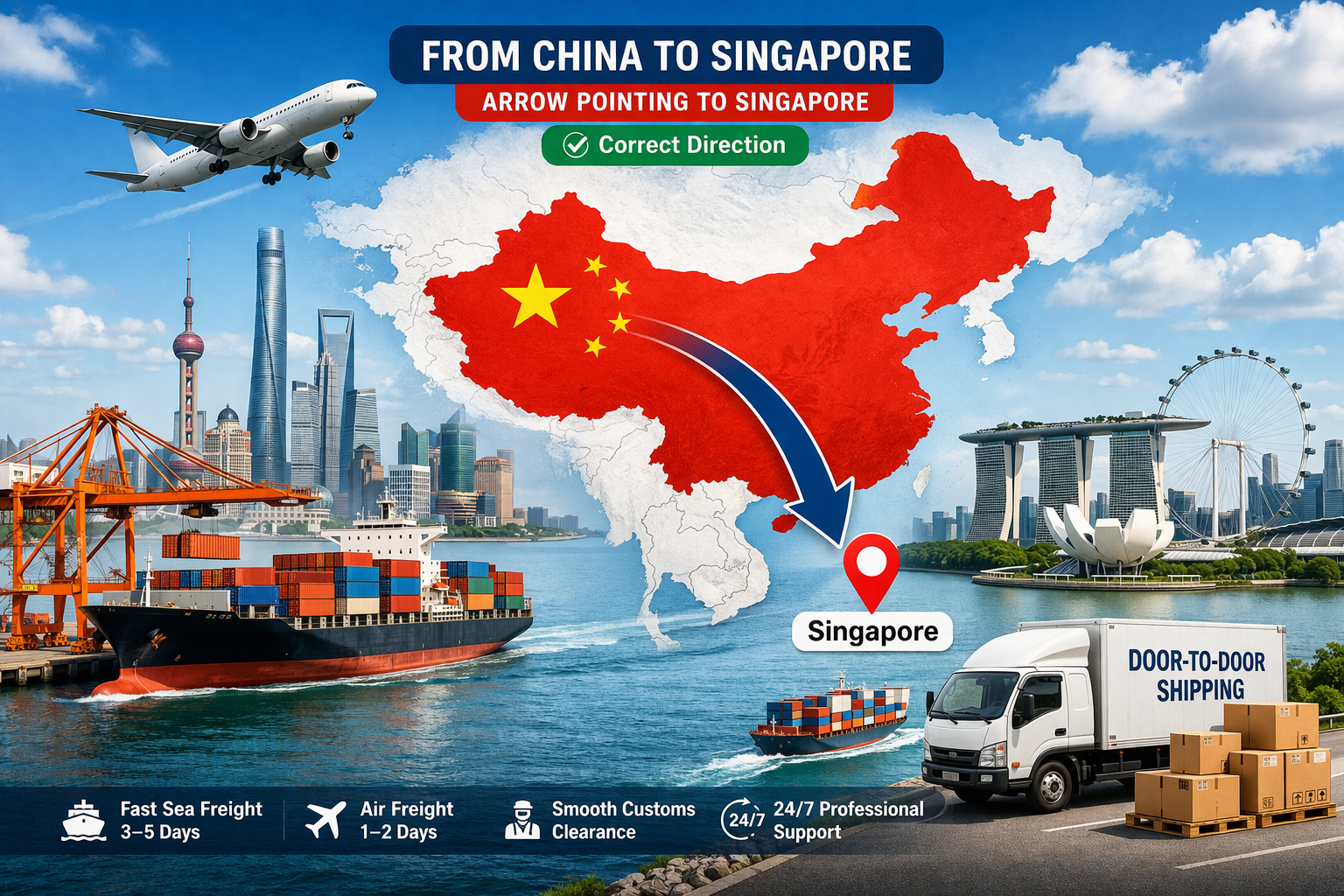
Shipping from China to Singapore is one of the most active trade lanes in Asia. China is Singapore’s largest trading partner, and bilateral goods trade reached S$162.85 billion in 2025 according to EnterpriseSG. That is one reason the route attracts frequent sailings, strong air-cargo capacity, and a wide range of door-to-door logistics options.
For importers, this route works well because Singapore has a trade-friendly customs system, a major transshipment port, and a globally connected air hub. At the same time, accurate documentation still matters: Singapore Customs requires import permits through TradeNet, and GST is charged on most imports at the prevailing rate of 9%.
China–Singapore Trade Volume and Import/Export Overview
The China–Singapore lane is important for both countries. China has been Singapore’s largest trading partner since 2013, and the China–Singapore Free Trade Agreement helps support predictable trade flows and business planning. In practical terms, this means the route sees steady movement of electronics, machinery, consumer goods, spare parts, retail inventory, and eCommerce cargo.
From a logistics perspective, the route is attractive because it combines short ocean distances, dense shipping schedules, and strong air connectivity. Singapore also serves as a regional distribution point, so many importers use the country not only for local consumption but also as a hub for onward Southeast Asia operations.
Transit Time Shipping from China to Singapore by Shipping Method
Transit time depends on the service level, routing, and customs handling. The table below gives a practical comparison for the main shipping methods used on this lane.
| Shipping method | Typical transit time | Best for | Notes |
|---|---|---|---|
| Sea freight | 7–14 days | Larger, heavier, or cost-sensitive cargo | LCL often takes longer because of consolidation and deconsolidation. |
| Air freight | 1–3 days | Urgent or high-value cargo | Faster but higher cost per kg. |
| International express | 1–5 days | Samples, parcels, small eCommerce shipments | Usually includes simplified tracking and faster handling. |
| DDU shipping | 4–18 days | Door-to-door cargo where duties are paid on arrival | Timing depends on whether the main leg is sea or air. DDU is still used informally in trade, although DAP is the modern Incoterms equivalent. |
Sea Freight | Shipping from China to Singapore
Sea freight is the most economical option for many importers. It is especially suitable when you are moving regular stock, bulk orders, or cargo that is too heavy for air freight to make sense. Because Singapore is a major transshipment hub, ocean services are frequent and well developed. PSA Singapore operates the world’s largest transshipment hub, and its terminals are built around high container throughput.
Sea Freight Rates from China to Singapore
The following table gives indicative sample rates from published market guides. These are not fixed quotations; they change with cargo type, season, space availability, and surcharges.
| Origin port in China | Destination | FCL 20GP | FCL 40GP | LCL (per CBM) |
|---|---|---|---|---|
| Shanghai | Singapore | USD 550–800 | USD 1,150–1,450 | USD 60–90 |
| Ningbo | Singapore | USD 650–1,050 | USD 1,150–1,550 | USD 65–95 |
| Shenzhen | Singapore | USD 550–950 | USD 1,050–1,400 | USD 55–85 |
| Guangzhou | Singapore | USD 550–950 | USD 1,050–1,400 | USD 55–85 |
| Qingdao | Singapore | USD 700–1,100 | USD 1,200–1,600 | USD 70–100 |
A second published guide lists a slightly different benchmark set for the same lane, which is normal in freight markets because rates move quickly and quotations depend on cargo profile and booking date.
Sea Freight Transit Time and What Affects It
For most shipments, sea freight from China to Singapore is fairly fast compared with long-haul lanes. Published guides place the route around 7–14 days for most sea movements, with LCL usually taking longer than FCL.
The main factors that affect transit time are:
- origin port choice
- vessel schedule frequency
- LCL consolidation timing
- customs inspections
- peak season congestion
- weather and port operations
Main Container Ports in China and Singapore
China’s major export container gateways on this route include Shanghai, Shenzhen, and Ningbo-Zhoushan. Shanghai Port handled more than 55.06 million TEUs in 2025, keeping its position as the world’s busiest container port for the 16th year in a row. Shenzhen Port is organized around major container areas such as Yantian, Nanshan, and Dachan Bay. Ningbo-Zhoushan continues to rank among the world’s largest and most connected port systems.
On the Singapore side, PSA Singapore operates 56 berths across the City Terminals, Pasir Panjang Terminals, and Tuas Port, with a designed annual capacity of 46.5 million TEUs. That level of infrastructure is one reason Singapore remains such a strong ocean freight destination.
Sea Freight Process and an Illustrative Case
A normal sea freight process looks like this:
- Confirm cargo details and Incoterms
- Book space with the forwarder
- Pick up cargo from the supplier
- Export declaration in China
- Load cargo at origin port
- Ocean transit to Singapore
- Import permit and customs clearance
- Final delivery or self-collection in Singapore
Illustrative case: a furniture importer in Singapore ships 12 CBM of flat-packed goods from Shenzhen. Because the shipment is under a full container load, LCL is selected. The forwarder consolidates the cargo, books the vessel, handles export paperwork, and arranges local Singapore clearance. This keeps the shipment cost-effective while avoiding the cost of a half-empty container.
Air Freight | Shipping from China to Singapore
Below are indicative air freight references from published market guides. As with sea freight, these should be treated as sample ranges rather than guaranteed live quotes.
| Origin airport in China | Sample air freight rate to Singapore | Typical reference weight basis |
|---|---|---|
| Shanghai PVG | USD 2.10 / kg | 100 kg / 300 kg |
| Shenzhen SZX | USD 2.15 / kg | 100 kg / 300 kg |
| Guangzhou CAN | USD 2.3 / kg | 100 kg / 300 kg |
| Beijing PEK | USD 2.40 / kg | 100 kg / 300 kg |
| Hong Kong HKG | USD 2.10 / kg | 100 kg / 300 kg |
A broader published range for China–Singapore air freight is roughly USD 1.90–3.30/kg, depending on airport, service level, and shipment size.
Air Freight Transit Time and What Affects It
Air freight is usually delivered in 1-2 days on this route, especially when the cargo is ready and the routing is direct or well connected.
The main factors that affect air freight time are:
- cargo cut-off time
- airline frequency
- chargeable weight and space availability
- security screening
- customs clearance speed
- peak season demand
Main International Airports in China and Singapore
Common China origin airports for this lane include Shanghai Pudong (PVG), Shenzhen Bao’an (SZX), Guangzhou Baiyun (CAN), and Beijing Capital (PEK). Shanghai Pudong is a major air cargo hub, Shenzhen Airport handled more than 2.05 million tons of cargo and mail in 2025, and Guangzhou Baiyun remains one of China’s leading cargo airports. Beijing Capital also has dedicated cargo terminal services.
On arrival, Singapore Changi Airport serves as the destination gateway, with strong cargo and regional connectivity.
Air Freight Process and an Illustrative Case
A typical air freight move follows this sequence:
- Confirm cargo dimensions and weight
- Get air freight quotation
- Pick up cargo and prepare export documents
- Airline booking and security screening
- Export departure from China
- Import clearance in Singapore
- Final delivery to warehouse or consignee
Illustrative case: a cosmetics importer needs 180 kg of samples for a product launch in Singapore. Sea freight would be too slow, so the shipment moves by air. The higher freight cost is justified because the goods arrive in time for the launch and help avoid stock-out risk.
International Express | Shipping from China to Singapore
Express shipping is ideal for small parcels, samples, spare parts, documents, and eCommerce orders. Providers such as DHL and UPS offer time-definite services, online tracking, and simplified handling. DHL Express Singapore’s 2025 rate guide confirms that parcel pricing is based on service and surcharges, while UPS Singapore publishes official rate guides and surcharge structures for the market.
For China–Singapore lanes, published market references commonly place express shipping around USD 3-3.5/kg in current market guides, though final pricing depends on weight, zone, and service level.
Typical express process: pickup, export handover, airline linehaul, customs clearance, and final delivery. This is the simplest shipping method for small, urgent consignments, but it becomes expensive once the shipment grows in size.
DDU Shipping | Shipping from China to Singapore
DDU is still widely used in trade conversations, even though it is not an official Incoterms 2020 rule. In practice, it usually means door-to-door delivery where import duties and GST are not prepaid by the seller. The modern Incoterms equivalent is generally DAP, while DDP is the version where the seller handles duties and taxes.
Common DDU Shipping Options
- sea DDU
- air DDU
- express DDU
- mixed door-to-door routing
DDU Shipping Rates
| DDU method | Sample rate | Typical delivery time |
|---|---|---|
| Sea DDU | Included in sea door-to-door quote; often priced from the ocean leg plus clearance and local delivery | 7–12 days |
| Air DDU | Often based on kg plus destination handling and delivery | 3-5 days in many door-to-door setups |
Singapore has few import restrictions, allowing even individuals to import goods. Therefore, Singapore typically doesn’t need to use DDP shipping, primarily relying on DDU.
DDU Shipping Transit Time and What Affects It
DDU transit time depends on the underlying transport mode, customs workload, and whether the cargo needs extra checks. In simple terms, DDU is not a separate transport network; it is a delivery arrangement that wraps around sea freight, air freight, or express movement.
DDU Shipping Process and an Illustrative Case
A standard DDU flow is:
- Supplier prepares cargo
- Forwarder books transport
- Cargo moves from China
- Goods arrive in Singapore
- Buyer pays duties/GST if applicable
- Cargo is released and delivered
Illustrative case: a small business orders mixed accessories from a supplier in Guangzhou. The forwarder ships the goods under a door-to-door DDU arrangement, but the importer is responsible for GST and any destination clearance charges. This works well when the buyer wants transport arranged end-to-end but still prefers to manage import taxes separately.
Key Things to Check Before Exporting from China
Product Type
You should first confirm whether the cargo is general goods, sensitive cargo, or battery-related cargo. Air freight providers often treat lithium battery cargo and dangerous goods separately because special handling and documentation may be required.
Supplier Export Capability
It is also important to check whether your supplier can legally export the goods and provide the correct shipping documents. If the supplier cannot support the export paperwork, your forwarder may need to use a different shipping structure or another compliant export arrangement.
Final Freight Confirmation
Freight prices change often, so final confirmation before cargo handover is essential. The rate you saw last week may not be the rate you get on the day of booking, especially during peak season or when space is tight.
What Singapore Importers Should Watch
Singapore Import Tax and GST
Singapore’s current GST rate is 9%. For imports, GST is charged on the taxable import value, which generally includes CIF value and any duty payable where applicable. Singapore Customs also requires import declarations to be made through TradeNet.
Most goods are not dutiable, but some categories are. Singapore Customs maintains a list of dutiable goods, and prohibited or controlled goods may require special approval before import.
Clearance Delays and Inspection Risk
Even a clean shipment can be delayed if the documents are incomplete or if the cargo is selected for inspection. Importers should therefore keep the invoice, packing list, permit, and supporting documents accurate and consistent. Singapore Customs also advises traders to retain trade documents for five years after permit approval.
FAQ: Shipping from China to Singapore
1. What is the cheapest way to ship from China to Singapore?
2. How long does shipping from China to Singapore take?
3. How much GST do I pay when importing into Singapore?
4. Do I need an import permit in Singapore?
5. What goods are restricted or prohibited in Singapore?
6. Is DDU still used in shipping?
Shipping from China to Singapore is efficient when you match the right transport mode to the cargo, prepare the paperwork properly, and plan for Singapore’s import rules in advance. Sea freight works best for cost-sensitive cargo, air freight is ideal for urgent shipments, express is convenient for parcels, and DDU can help simplify door-to-door delivery when the buyer is comfortable handling import charges at destination.
ApexLink's shipping solutions from China to Singapore
-
Sea Freight (FCL/LCL)/Air Freight/Express
-
Flexible Door-to-Door (DDP/DDU) Services
-
Simple and Efficient Customs Clearance
-
24/7 Professional Support and Fast Response