How to Book and Ship a DG Container from China
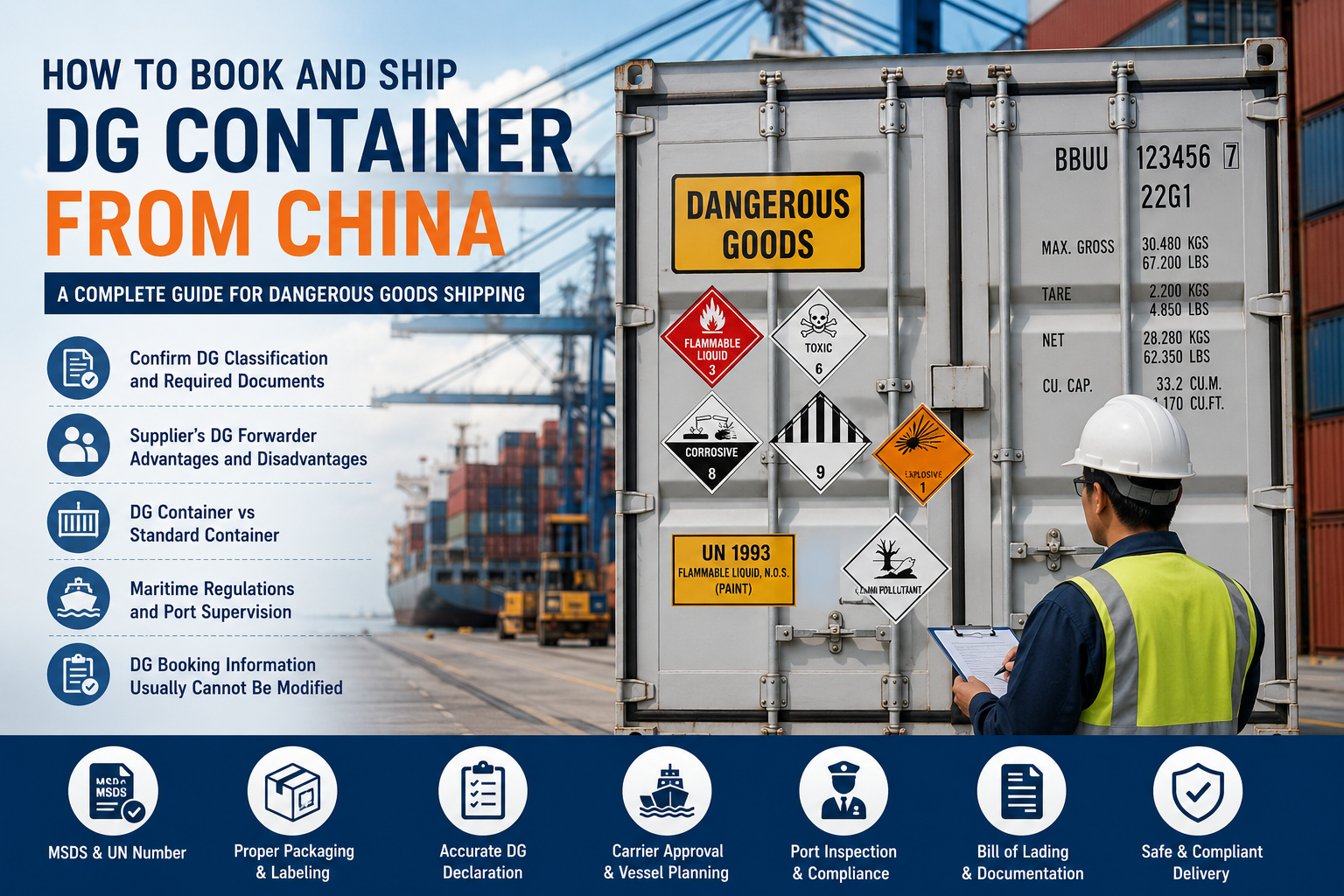
Shipping dangerous goods from China is far more complicated than arranging a normal container shipment. Unlike standard cargo, DG (Dangerous Goods) shipments involve strict maritime regulations, carrier approvals, port supervision, specialized packaging, and detailed documentation procedures.
Therefore, importers and exporters must understand the entire DG shipping process before booking cargo. Even a small mistake can result in container rejection, port fines, customs delays, cargo rollover, or vessel safety issues.
In this guide, we will explain how DG container shipping works from China, how to identify dangerous cargo, how suppliers arrange DG shipments, the operational differences between DG and standard containers, and why DG booking information usually cannot be modified after approval.
What Is a DG Container?
A DG container is a shipping container used for transporting dangerous goods under international maritime regulations.
These goods may include:
- Lithium batteries
- Chemicals
- Paints
- Aerosols
- Flammable liquids
- Industrial gases
- Corrosive materials
- Cleaning products
- Adhesives
Because these products may create fire, explosion, leakage, or environmental risks during transportation, ports and shipping lines apply much stricter handling procedures than normal cargo shipments.
As a result, DG container shipping requires professional operational management from the factory all the way to the destination port.
1. Confirm Whether Your Cargo Is Dangerous Goods and Identify the DG Class
Before arranging any shipment, the first step is determining whether the cargo belongs to dangerous goods under IMO regulations.
This step is extremely important because incorrect declarations may lead to severe penalties or shipment rejection.
How to Confirm Whether Cargo Is DG
Normally, manufacturers or suppliers can provide technical documentation for classification.
The most important documents include:
- MSDS (Material Safety Data Sheet)
- UN Number
- DG Class
- Packing Group
- Product technical specifications
Among these documents, the MSDS is the key reference used by shipping lines, freight forwarders, and ports.
Without a proper MSDS, most carriers will refuse to review the booking.
Understanding UN Numbers
Every dangerous product is assigned a UN number for international transportation identification.
For example:
| Product | Example UN Number |
|---|---|
| Lithium batteries | UN3480 |
| Paint | UN1263 |
| Aerosol products | UN1950 |
| Flammable liquids | UN1993 |
The UN number determines:
- Hazard category
- Packing requirements
- Labeling standards
- Emergency handling procedures
- Vessel loading restrictions
Therefore, using the correct UN number is critical.
Main Dangerous Goods Classes
International dangerous goods regulations divide cargo into 9 classes.
| DG Class | Description |
|---|---|
| Class 1 | Explosives |
| Class 2 | Gases |
| Class 3 | Flammable liquids |
| Class 4 | Flammable solids |
| Class 5 | Oxidizers and organic peroxides |
| Class 6 | Toxic substances |
| Class 7 | Radioactive materials |
| Class 8 | Corrosive substances |
| Class 9 | Miscellaneous dangerous goods |
Many common export products from China belong to Class 3 or Class 9 categories.
For example:
- Paints and coatings are often Class 3
- Lithium batteries are usually Class 9
- Certain cleaning chemicals may belong to Class 8
Because different DG classes follow different vessel loading rules, accurate classification is essential.
The Importance of Packing Groups
Dangerous goods may also include packing groups:
- Packing Group I — High danger
- Packing Group II — Medium danger
- Packing Group III — Low danger
The packing group affects:
- Packaging standards
- Container loading rules
- Emergency procedures
- Carrier approval difficulty
Consequently, products with higher risk classifications often face stricter transportation requirements.
Common Mistakes During DG Classification
Many exporters experience problems during the first DG shipment.
The most common mistakes include:
- Using outdated MSDS documents
- Incorrect UN numbers
- Misdeclaring DG cargo as general cargo
- Missing packing group information
- Incorrect technical product names
As a result, carriers may reject the booking even before container loading begins.
Additional Documents Required for DG Shipping
Compared with standard sea freight shipments, DG cargo requires significantly more paperwork.
Normally, exporters must prepare:
- MSDS
- Dangerous Goods Declaration (DGD)
- UN packaging certificate
- Container Packing Certificate
- Commercial invoice
- Packing list
- Booking confirmation
- Emergency contact information
Some shipping lines may also require laboratory reports or battery test reports.
Therefore, document preparation should begin early.
2. Suppliers Usually Arrange DG Shipments Through Their Own Freight Forwarders
In China, many factories already cooperate with local DG freight forwarders. Therefore, suppliers often recommend using their own logistics partners.
This arrangement can improve operational efficiency in some situations. However, it also creates several risks for importers.
Advantages of Using the Supplier’s DG Freight Forwarder
Faster Factory Coordination
The supplier and freight forwarder already understand:
- Product specifications
- Packaging details
- Factory loading procedures
- DG declaration requirements
As a result, communication becomes faster and smoother.
Easier DG Documentation Handling
Since the supplier already controls the product information, they can quickly provide:
- MSDS
- UN number confirmation
- Packaging details
- DG labels
Therefore, the booking process may move more efficiently.
Better Local Port Experience
Chinese DG export regulations can vary by port.
Experienced local DG forwarders usually understand:
- Port restrictions
- Terminal procedures
- Carrier-specific DG policies
- Cut-off times for DG cargo
Consequently, they may resolve operational issues more quickly.
Disadvantages of Using the Supplier’s Forwarder
Limited Shipping Transparency
Sometimes the buyer does not receive full logistics visibility.
For example, the supplier may control:
- Freight pricing
- Shipping schedules
- Carrier selection
- Routing details
- Destination agent information
As a result, importers may lose shipment control.
Possible Information Exposure
Many importers want to keep supplier and consignee information confidential.
However, when the supplier controls the DG shipment, commercial information may become visible to multiple parties.
This issue becomes especially important for:
- Trading companies
- E-commerce brands
- High-margin importers
- Exclusive product distributors
Therefore, some buyers prefer using independent freight arrangements.
Less Flexibility During Shipment Changes
If shipment information changes unexpectedly, communication may become complicated because multiple parties are involved.
For example:
- Factory
- Supplier’s freight forwarder
- Shipping line
- Buyer
- Destination customs broker
Consequently, delays become more likely.
Why DG Shipping Costs Are Higher Than Standard Cargo
Many importers are surprised by DG shipping surcharges.
However, dangerous goods shipments involve additional operational risks and compliance requirements.
Common DG-related charges include:
- DG declaration fees
- Port dangerous goods handling fees
- Emergency response surcharges
- Specialized documentation fees
- DG container inspection fees
- Carrier DG surcharges
Additionally, some shipping lines limit DG container quantities on each vessel. Therefore, DG space availability can become very tight during peak seasons.
3. Differences Between DG Containers and Standard Containers During Loading
DG containers cannot be loaded the same way as normal cargo containers.
Instead, dangerous goods must follow strict safety regulations throughout the loading process.
DG Labeling Requirements
Every DG container must display approved hazard labels.
These labels normally include:
- DG class labels
- UN number markings
- Marine pollutant labels
- Emergency warning signs
Without correct labeling, ports may reject the container before terminal entry.
Therefore, labeling accuracy is extremely important.
Cargo Segregation Rules
Certain dangerous goods cannot be stored together.
For example:
- Oxidizers cannot be near flammable liquids
- Toxic substances require separation from food cargo
- Some chemicals react dangerously when mixed
As a result, shipping lines carefully review container loading plans before approval.
Specialized Packaging Standards
DG cargo packaging must comply with UN-certified standards.
Unlike standard cargo cartons, DG packaging must pass:
- Drop tests
- Pressure tests
- Leakage tests
- Vibration tests
Therefore, ordinary export cartons may not qualify for dangerous goods transportation.
Container Ventilation Requirements
Some dangerous cargo emits gas or vapor during transportation.
Therefore, certain DG containers may require:
- Ventilated containers
- Temperature-controlled storage
- Special stowage positions on the vessel
These operational requirements directly affect carrier approval.
Weight Distribution and Cargo Securing
Dangerous cargo must be securely fastened inside the container.
Improper securing may cause:
- Cargo movement
- Leakage
- Fire risks
- Container imbalance
Consequently, ports and shipping lines pay close attention to lashing and securing quality.
DG Warehouse and Port Restrictions
Unlike standard cargo, DG cargo usually cannot remain at the terminal for extended periods.
Many ports enforce:
- Shorter storage periods
- Strict cut-off schedules
- Dedicated DG storage areas
- Limited weekend operations
Therefore, exporters must coordinate trucking and terminal delivery carefully.
4. Maritime Regulations and Port Supervision You Need to Understand
DG cargo shipping is heavily regulated by maritime authorities worldwide.
Unlike normal cargo, dangerous goods shipments are monitored at almost every stage of transportation.
IMO and IMDG Code Compliance
International dangerous goods shipping mainly follows:
- IMO regulations
- IMDG Code
- Carrier safety policies
- Local port restrictions
These regulations govern:
- Packaging
- Labeling
- Documentation
- Container loading
- Cargo segregation
- Emergency response procedures
Therefore, compliance is not optional.
Port DG Inspection Procedures
Ports may inspect DG containers before vessel loading.
Inspection items often include:
- Packaging condition
- Container cleanliness
- Hazard labels
- Cargo securing
- Declaration consistency
- Container damage
If inspectors discover problems, the container may be detained immediately.
Consequently, even small operational mistakes can create major delays.
Vessel DG Approval Process
Before loading dangerous cargo onto a vessel, the shipping line must review the booking carefully.
The approval process usually includes:
- MSDS review
- DG application submission
- Vessel compatibility review
- Port acceptance confirmation
- Stowage planning approval
Because of these extra procedures, DG bookings normally require longer lead times than standard shipments.
Emergency Response Requirements
Shipping lines and ports must prepare emergency response procedures for dangerous cargo.
These procedures may include:
- Fire response plans
- Spill control procedures
- Isolation protocols
- Emergency contact systems
As a result, carriers carefully limit the quantity and location of DG containers onboard.
High-Risk DG Cargo Restrictions
Some dangerous goods face especially strict controls.
Examples include:
- Self-heating materials
- High-capacity lithium batteries
- Toxic gases
- Explosive materials
In certain cases, carriers may refuse transportation entirely.
Therefore, cargo routing flexibility can become limited.
5. DG Bill of Lading and Booking Information Usually Cannot Be Modified
One of the most important facts about DG shipping is that dangerous goods booking information is extremely difficult to change after approval.
Unlike standard cargo shipments, DG bookings are connected directly to vessel safety planning.
Why DG Information Cannot Be Easily Changed
Once the carrier approves the shipment, the following information becomes part of the vessel loading plan:
- UN number
- DG class
- Packaging type
- Cargo description
- Container quantity
- Flash point information
- Emergency response classification
Therefore, changing shipment details later may require complete re-approval.
Common Changes That Create Problems
The following modifications often trigger operational issues:
- Changing consignee information
- Revising cargo descriptions
- Modifying weight details
- Updating container quantity
- Changing packaging type
- Adjusting UN number information
Consequently, even small amendments may delay the shipment significantly.
Potential Consequences of Late Amendments
Late DG shipment changes may lead to:
- Cargo rollover
- Rejection by the shipping line
- Additional DG handling charges
- Customs delays
- Port storage fees
- Missed vessel schedules
Therefore, exporters should verify all booking information carefully before submission.
Why Accurate Documentation Is Critical
For dangerous goods shipments, documentation accuracy directly affects:
- Vessel safety
- Customs clearance
- Insurance validity
- Carrier liability
- Emergency response procedures
As a result, incorrect information can create legal and financial risks for all parties involved.
Common DG Shipping Mistakes Exporters Should Avoid
Incorrect MSDS Versions
Some factories continue using outdated documentation. Consequently, carriers may reject the booking.
Improper DG Packaging
Non-certified packaging remains one of the biggest causes of shipment refusal.
Therefore, exporters should always verify UN packaging compliance.
Last-Minute Bookings
DG approval takes longer than normal cargo approval.
As a result, last-minute bookings often fail during peak shipping seasons.
Incorrect Cargo Descriptions
Using inaccurate cargo descriptions may create serious compliance risks.
In extreme cases, carriers may blacklist the shipper.
Missing DG Labels
Without proper hazard labels, terminals may refuse container entry immediately.
Therefore, labeling checks should happen before trucking delivery.
Practical Tips for Smooth DG Container Shipping from China
To reduce operational risks and improve shipping efficiency:
- Prepare MSDS documents early
- Confirm DG classification before production
- Use certified DG packaging
- Book space earlier than standard cargo
- Double-check all booking information
- Confirm destination country import regulations
- Verify carrier DG acceptance policies
- Coordinate factory loading schedules carefully
Good preparation significantly reduces shipment delays and unexpected costs.
FAQ About DG Container Shipping from China
What does DG mean in shipping?
DG stands for Dangerous Goods. These are products classified as hazardous during transportation under international regulations.
Is DG shipping more expensive than normal shipping?
Yes. DG shipments involve additional handling, documentation, inspection, and compliance requirements.
How long does DG booking approval usually take?
Normally between 2–7 working days depending on the cargo type, carrier, and port restrictions.
Can all shipping lines accept dangerous goods?
No. Different carriers accept different DG classes and apply different restrictions.
Why are DG bill of lading changes difficult?
Because dangerous goods approvals are tied directly to vessel safety planning and stowage arrangements.
Do lithium batteries require DG shipping?
Many lithium batteries require DG handling under Class 9 regulations. However, requirements depend on battery type and capacity.
What happens if DG cargo is declared incorrectly?
ncorrect declarations may lead to:
- Heavy fines
- Cargo seizure
- Shipment rejection
- Vessel safety risks
- Legal liability
Therefore, accurate declarations are extremely important.
Related Posts
- FOB Container Shipping Costs: What You Need to Know
- Containers fell from the Mississippi container ship at Long Beach
- A Practical Guide to International Shipment of Lithium Batteries from China
- Shipping from China to the USA: A Complete Guide for Importers in 2026
- Beginner’s Guide Before Shipping from China: What Importers Must Confirm in Advance