
DDP SHIPPING FROM CHINA: DOOR-TO-DOOR DELIVERY INCLUDING TAX
China remains one of the largest manufacturing hubs in the world. Every year, millions of shipments leave Chinese factories and travel to customers across Europe, North America, the Middle East, and Southeast Asia.
However, international shipping often involves complex procedures. Importers must handle export documentation, customs clearance, import duties, and final delivery arrangements.
For this reason, many businesses choose DDP shipping from China.
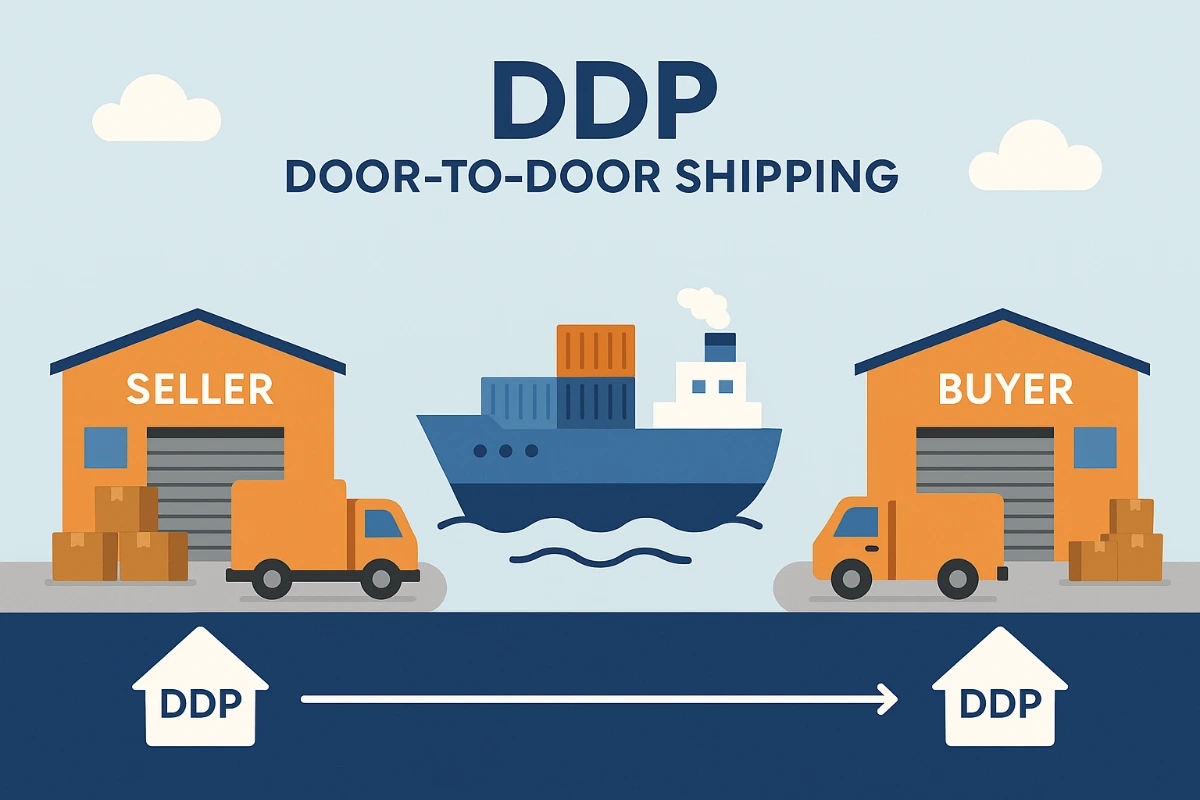
DDP (Delivered Duty Paid) shipping provides a door-to-door logistics solution in which the freight forwarder manages transportation, customs clearance, tax payments, and final delivery.
As a result, importers receive their goods without dealing with complicated customs procedures.
What Is DDP Shipping from China?
DDP shipping from China refers to a logistics arrangement where the freight forwarder or seller takes responsibility for delivering goods from China directly to the buyer’s destination.
Under DDP terms, the logistics provider usually manages several key stages:
Export customs clearance in China
International transportation
Import customs clearance in the destination country
Payment of duties and taxes
Final delivery to the consignee’s address
Therefore, the buyer receives the shipment as a completed delivery service.
This arrangement significantly reduces administrative work for importers. Instead of coordinating multiple service providers, the buyer communicates with a single freight forwarder who manages the entire shipment.
How DDP Shipping from China Works
Although DDP shipping appears simple from the buyer’s perspective, the logistics process still includes several important stages.
Understanding these steps helps businesses manage their supply chain more effectively.
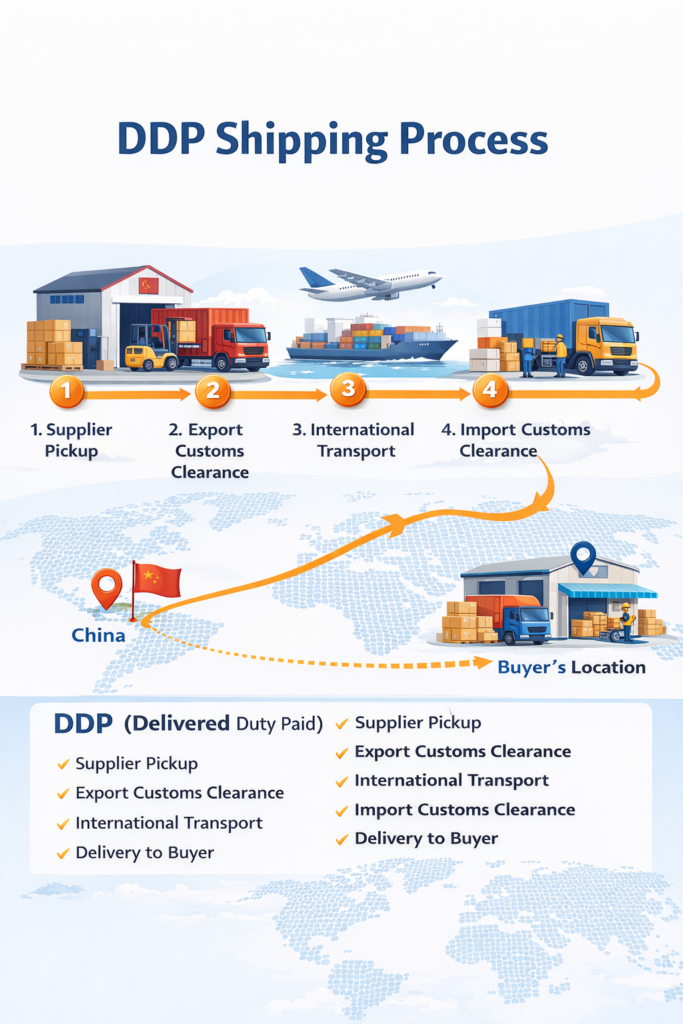
1. Cargo Pickup from the Supplier
The process begins when the freight forwarder collects cargo from the supplier’s warehouse in China.
In many cases, the forwarder also checks the cargo packaging, verifies documentation, and prepares export paperwork.
As a result, the shipment becomes ready for international transportation.
2. Export Customs Clearance in China
After the cargo arrives at the export terminal or warehouse, the freight forwarder arranges customs declaration procedures.
Chinese customs authorities review export documentation and verify the cargo details.
Once customs clearance is completed, the shipment can leave China.
3. International Transportation
Next, the cargo enters international transportation.
Depending on shipment size and delivery urgency, importers can choose different transport methods:
Air freight
Rail freight
International express shipping
Each method offers different transit times and transportation costs.
4. Import Customs Clearance
When the cargo arrives in the destination country, the freight forwarder’s local partner manages import customs procedures.
This step usually includes duty payments, customs documentation review, and cargo inspection if required.
Once the shipment clears customs, it can continue to the final delivery stage.
5. Final Delivery to the Consignee
Finally, the shipment is delivered to the buyer’s warehouse, office, or distribution center.
Depending on the destination, delivery may occur through local trucking companies or courier services.
As a result, the entire shipment process becomes a complete door-to-door logistics service.
Shipping Methods for DDP Shipping from China
DDP shipping from China supports multiple transportation modes. Businesses typically choose the best option based on shipment size, budget, and delivery deadlines.
Air Freight DDP Shipping
Air freight provides one of the fastest DDP shipping solutions.
Transit times usually range between 5 and 10 days, depending on the destination and airline schedules. As a result, many businesses use air freight for urgent shipments or high-value products.
In addition, air freight works well for smaller shipments that require fast delivery.
However, air freight costs more than other transportation methods. Therefore, companies usually reserve this option for time-sensitive cargo.
Sea Freight DDP Shipping
Sea freight remains the most cost-effective solution for large shipments.
Typical transit times range from 25 to 40 days, depending on the shipping route and port congestion.
Sea freight DDP services usually include two shipping options:
FCL (Full Container Load) for large shipments
LCL (Less-than-Container Load) for smaller cargo volumes
Because ocean freight significantly reduces transportation costs, many businesses rely on this method for regular inventory shipments.
Railway DDP Shipping to Europe
Rail freight has become increasingly popular for shipments between China and Europe.
The China–Europe Railway Express connects major Chinese logistics hubs with European cities such as Warsaw, Hamburg, and Madrid. As a result, businesses can transport goods across Eurasia faster than sea freight.
Transit times typically range between 15 and 20 days, which makes rail transport an attractive middle option between air freight and ocean freight.
In addition, railway DDP shipping allows freight forwarders to manage customs clearance procedures along the route. Therefore, the cargo can move smoothly from China to Europe under a door-to-door delivery arrangement.
For many European importers, rail freight offers an excellent balance between shipping speed and transportation cost.
Truck DDP Shipping to Europe
Truck transportation also plays an important role in China–Europe logistics.
Through cross-border road freight corridors, trucks can transport goods from western China to Central Asia and then continue toward Europe.
Transit times usually range from 12 to 18 days, depending on border crossings and road conditions.
One major advantage of truck DDP shipping is flexibility. Trucks can travel directly from factories to warehouses without relying on fixed port or rail schedules.
As a result, many companies choose truck transport for time-sensitive shipments, e-commerce goods, and medium-sized cargo.
Furthermore, truck transport allows freight forwarders to provide complete door-to-door DDP services across multiple countries.
Express Courier DDP Shipping
For small shipments, international courier services offer the fastest logistics solution.
Courier companies operate integrated logistics networks that combine air transport, customs clearance, and local delivery.
Transit times usually range from 3 to 7 days.
Therefore, express DDP shipping works well for:
product samples
small parcels
urgent documents
However, this option typically costs more than standard freight services.
Risks of DDP Shipping
DDP (Delivered Duty Paid) shipping offers a convenient logistics solution. Under this arrangement, the freight forwarder handles transportation, customs clearance, import duties, and final delivery to the consignee.
As a result, many importers prefer DDP shipping because it simplifies international logistics.
However, DDP shipping also involves several potential risks. Before choosing this method, importers should understand the following issues.
1. Security and Compliance Risks
DDP shipping is essentially a tax-included delivery service. In most cases, the destination agent acts as the importer of record during customs clearance. After customs clearance and tax payment, the goods are transferred to the actual consignee through local courier or logistics services.
However, problems may occur if the customs agent lacks experience with import procedures.
For example, some agents may declare cargo with extremely low values in order to reduce duties. Although this practice lowers costs, it also increases the risk of customs inspections. If customs authorities detect incorrect declarations, they may detain the cargo or even confiscate it.
In addition, exporters should also pay attention to cargo compliance. If a freight forwarder secretly adds sensitive or restricted goods to the shipment, customs authorities may conduct additional inspections. As a result, the cargo could face delays or seizure.
Therefore, importers should always work with reliable and transparent logistics providers.
2. Delivery Delay Risks
DDP shipping is a door-to-door service after duty payment. Because the freight forwarder manages more logistics stages, the process naturally includes more potential points of failure.
In many cases, delays occur due to customs inspections, policy adjustments, or documentation issues.
For example, if your shipment contains general cargo, customs inspection may delay delivery for about one week.
However, if your shipment includes sensitive goods, the delay could be much longer. Products such as batteries, cosmetics, or electronic items often require additional compliance checks. As a result, the customs clearance process may take several weeks.
Therefore, businesses that rely on strict delivery schedules should carefully evaluate the risks before choosing DDP shipping.
3. Tax and Documentation Risks
Importers should also understand the tax implications of DDP shipping.
In many DDP shipments, freight forwarders cannot provide official import tax receipts or master bills of lading. This situation usually occurs because DDP cargo often ships under consolidated LCL shipments.
As a result, the bill of lading may include multiple cargo owners and sensitive business information. Similarly, import tax documents may contain confidential data that logistics providers cannot disclose.
Instead, importers usually receive a freight forwarder’s cargo receipt or delivery document as proof of shipment.
However, this situation may create challenges during tax audits. For example, if local tax authorities review your business records, they may ask for import documentation to verify product costs.
That said, occasional DDP shipments rarely attract attention from tax authorities. Nevertheless, businesses that import goods frequently or in large volumes should consider using their own company credentials for customs clearance and tax declaration.
Advantages of DDP Shipping
Despite these risks, DDP shipping still provides several significant advantages.
First, it simplifies the entire logistics process. The freight forwarder manages transportation, customs clearance, and final delivery. As a result, importers do not need to deal with complex customs procedures.
Second, DDP shipping improves cost predictability. Because duties and taxes are already included, businesses can calculate the total logistics cost more easily.
In addition, DDP shipping works well for new importers and small businesses. Many companies lack experience with international customs regulations. Therefore, DDP shipping allows them to import products without building their own logistics infrastructure.
Finally, DDP shipping reduces administrative workload. Instead of managing multiple logistics providers, businesses work with a single freight forwarder who coordinates the entire shipment.
Who Should Use DDP Shipping?
Not every importer needs DDP shipping. In fact, the best logistics solution depends on the size and structure of the business.
Small Importers and E-commerce Sellers
DDP shipping is often ideal for small importers, startups, and e-commerce sellers. These businesses usually prioritize convenience and predictable costs.
For example, Amazon sellers and online retailers often prefer DDP services because they allow them to receive goods quickly without handling complex customs procedures.
Occasional Importers
Companies that import goods occasionally may also benefit from DDP shipping. Since they do not ship frequently, building their own customs clearance system may not be necessary.
Businesses Without Local Import Licenses
In some countries, importers must hold specific licenses or tax registrations. If a company does not have these documents, DDP shipping can provide an alternative solution.
Do You Really Need DDP Shipping?
Although DDP shipping is convenient, it may not be the best option for every business.
For example, companies that import large volumes of goods regularly often benefit from handling customs clearance themselves. By using their own company letterhead and tax registrations, they gain better control over import documentation and tax compliance.
In these cases, shipping terms such as DAP (Delivered at Place) or DDU (Delivered Duty Unpaid) may provide more transparency and lower long-term risks.
Therefore, businesses should evaluate their logistics strategy carefully. Choosing the right shipping method can improve supply chain efficiency while reducing compliance risks.
DDP vs DAP vs DDU: Key Differences
Understanding the differences between shipping terms is essential for choosing the right logistics strategy.
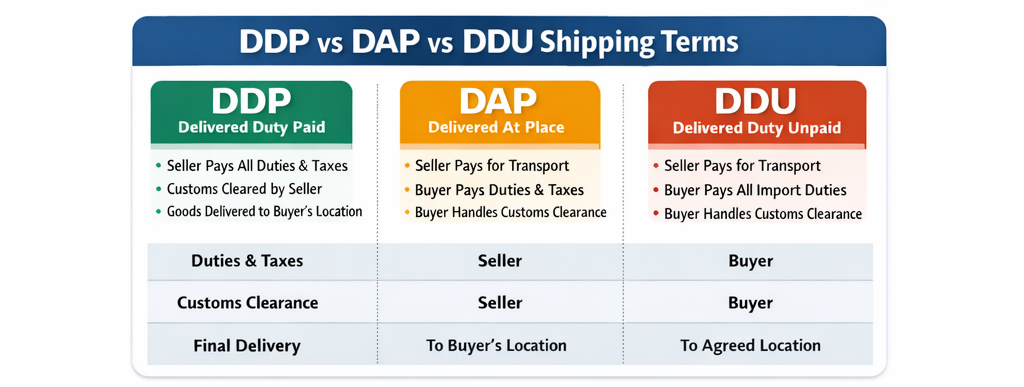
DDP(Delivered Duty Paid), the seller handles transportation, customs clearance, and import duties.
DAP(Delivered At Place), the seller pays for transportation to the destination, but the buyer handles customs clearance and import duties.
DDU (Delivered Duty Unpaid), which is now largely replaced by DAP, the buyer also takes responsibility for paying import duties.
As a result, DDP offers the most convenience for buyers, while DAP provides more transparency and control.
Why Choose the “ApexLink Shipping ” Service?
✅ Simplified Import Process
No need for buyers to handle customs clearance, duties, or VAT.
No import license required—our team manages everything.
Avoid delays or penalties caused by paperwork errors.
✅ Transparent & All-Inclusive Costs
Final price includes all fees—no hidden charges.
No need to estimate customs duties; everything is pre-calculated.
Lower import costs with no separate customs brokerage fees.
✅ Convenient Delivery to Buyer’s Door
True “door-to-door” service—just wait for delivery.
Multiple transport modes to fit cost and speed needs.
Direct delivery to Amazon FBA or other e-commerce warehouses.
FAQ – DDP Shipping From China
What is DDP shipping?
DDP shipping means the seller takes full responsibility for delivering goods to the buyer’s location, including customs clearance and import duties.
Is DDP shipping safe?
DDP shipping is generally safe when handled by experienced freight forwarders. However, importers should verify that the logistics provider follows proper customs compliance procedures.
What is the difference between DDP and DAP?
Under DDP, the seller pays import duties and handles customs clearance. Under DAP, the buyer is responsible for customs clearance and import taxes.
Is DDP shipping expensive?
DDP shipping often includes all logistics costs in one price. While it may appear more expensive initially, it simplifies logistics management and reduces administrative work.
Why do many importers use DDP shipping from China?
Many importers prefer DDP shipping from China because it provides a convenient door-to-door solution. The freight forwarder manages customs clearance and tax payments.
Can Amazon sellers use DDP shipping?
Yes. Many Amazon sellers use DDP shipping to send inventory directly from Chinese suppliers to Amazon fulfillment centers.
Do I receive tax documents with DDP shipping?
Not always. Some freight forwarders cannot provide official tax receipts because the customs declaration may be filed under their local partner’s company.
When should I avoid DDP shipping?
Businesses that import large volumes regularly should consider handling customs clearance themselves. This approach provides better tax documentation and regulatory control.
How DDP Shipping Cost is Calculated?
DDP Price = Export Customs Fee + International Freight + Insurance + Import Duty + VAT + Customs Clearance at Destination + Final Delivery + Other Surcharges