
INTERMODAL TRANSPORT FROM CHINA: FLEXIBLE AND EFFICIENT GLOBAL FREIGHT SOLUTIONS
Shipping goods across continents often requires more than one type of transportation. Instead of relying on a single method, many companies combine multiple transport modes to improve efficiency and reduce costs. This is where intermodal transport from China becomes a powerful logistics solution.
Intermodal transport refers to the movement of cargo using two or more transportation modes, such as sea, rail, truck, or air. Each mode handles a specific segment of the journey while the cargo remains in the same container. As a result, shippers avoid unnecessary cargo handling and reduce the risk of damage.
At Apexlink Shipping, we design customized intermodal transport solutions that connect Chinese factories with global markets. By combining different transport networks, we help businesses achieve faster delivery times, improved reliability, and better freight costs.
What Is Intermodal Transport?
Intermodal transport describes a logistics strategy where a shipment travels through multiple transportation modes under a single logistics plan. Typically, the cargo stays inside the same container throughout the journey.
For example, a shipment may leave a factory in China by truck. Next, it moves to a railway terminal and travels across Asia by train. Finally, a truck delivers the container to the final destination warehouse.
Because the cargo remains sealed inside the container, the transfer between transport modes becomes faster and safer. Consequently, intermodal transport improves efficiency while maintaining cargo security.
How Intermodal Transport from China Works
Intermodal logistics follows a coordinated process that connects different transportation networks. Each stage plays a role in ensuring smooth delivery.
1.Cargo Collection
First, the shipment is collected from the supplier’s factory in China. Trucks usually transport the cargo to a nearby rail terminal, seaport, or logistics hub.
2.Container Loading
Next, the goods are loaded into standardized containers. These containers can move easily between trucks, trains, and vessels without unloading the cargo itself.
3.Multi-Mode Transportation
After loading, the shipment travels through several transportation modes depending on the route. For instance, it may move by rail across Central Asia and then continue by truck to a European destination.
4. Final Delivery
Finally, the container reaches the destination logistics hub. From there, trucks deliver the cargo directly to the consignee’s warehouse or distribution center.
This coordinated process allows logistics providers to combine speed, cost efficiency, and route flexibility.
Common Intermodal Transport Combinations
Intermodal shipping from China can include several transport combinations. Each option suits different shipping needs.
Sea + Truck Transport
This is one of the most common intermodal solutions. Cargo first travels by ocean freight from China to an overseas port. Then trucks deliver the shipment to the final destination.
This option works well for global shipments to North America, Europe, and Australia.
Rail + Truck Transport
Railway transport connects China with many European countries through the China-Europe railway network. Once the train reaches a European logistics hub, trucks handle the final delivery.
As a result, this method balances speed and cost effectively.
Sea + Rail Transport
In this combination, containers move by ocean freight to a major port. Afterwards, trains transport the cargo inland to cities that are far from seaports.
This option is particularly useful for inland destinations across Europe or Central Asia.
Air + Truck Transport
Air freight provides the fastest international transport. After the aircraft arrives, trucks distribute the cargo to nearby cities or warehouses.
Therefore, this solution works best for urgent or high-value goods.
Advantages of Intermodal Transport from China
Lower Transportation Costs
By combining efficient transport modes, companies can reduce overall shipping costs. For instance, rail transport may replace expensive air freight for long-distance shipments.
Improved Cargo Safety
Containers remain sealed throughout most of the journey. Because the cargo is not frequently handled, the risk of damage or loss decreases significantly.
Greater Route Flexibility
Intermodal logistics allows freight forwarders to adjust routes based on capacity, seasonal demand, or transport disruptions. As a result, shipments can avoid congestion at major ports.
Environmental Benefits
Rail transport produces significantly fewer carbon emissions compared to air or road freight. Therefore, many companies use intermodal transport to support sustainable supply chains.
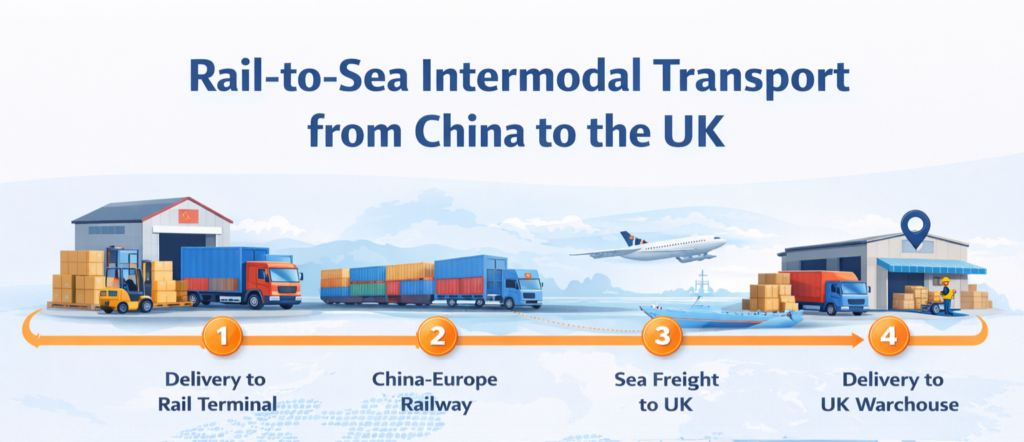
Real Case Study: Rail-to-Sea Intermodal Transport from China to the UK
A UK-based electronics distributor needed to ship 10 containers of consumer electronics from Shanghai to London. The client wanted a faster and more cost-effective solution than full sea freight, but shipping by air would be too expensive.
To address this, Apexlink Shipping designed a rail-to-sea intermodal route:
Step 1: Trucks collected the containers from the Shanghai factory and delivered them to a nearby rail terminal.
Step 2: The containers traveled by the China-Europe railway to Duisburg, Germany. This rail segment significantly reduced transit time compared with ocean freight alone.
Step 3: From Duisburg, the containers were transported by ocean freight from the Port of Hamburg to the Port of Felixstowe in the UK.
Step 4: Finally, trucks delivered the containers directly to the client’s London warehouse.
This intermodal solution reduced total transit time to 32 days, compared with 45-50 days for standard sea freight. Meanwhile, the client saved nearly 35% of the cost compared with air freight.
Thanks to this successful shipment, the client adopted rail-to-sea intermodal transport as their preferred solution for future shipments from China to the UK and wider Europe.
Why Choose Apexlink for Intermodal Transport
Apexlink Shipping provides integrated logistics services for international shippers. Our team coordinates multiple transportation networks to ensure smooth cargo movement.
Our services include:
-
Global container shipping solutions
-
China–Europe rail freight coordination
-
Multimodal cargo tracking systems
-
Customs clearance support
-
Door-to-door delivery options
Because we manage each step of the logistics chain, our clients receive reliable and transparent transport services.
FAQ: Intermodal Transport from China
What is the difference between intermodal and multimodal transport?
Intermodal transport uses multiple transportation modes while keeping the cargo inside the same container. In contrast, multimodal transport may involve transferring cargo between containers during the journey.
Is intermodal transport cheaper than air freight?
Yes, in most cases intermodal transport costs significantly less than air freight. Rail and sea segments reduce transportation costs while still maintaining reasonable transit times.
How long does intermodal transport from China to Europe take?
Transit time usually ranges from 15 to 25 days, depending on the route and destination. Rail-based intermodal routes are typically faster than sea freight.
What types of cargo are suitable for intermodal transport?
Most general cargo works well with intermodal shipping. Common products include electronics, machinery, furniture, textiles, and e-commerce goods.
Is intermodal transport safe for international shipments?
Yes. Containers remain sealed during most of the journey. Because the cargo is not repeatedly handled, the risk of damage is relatively low.
Can intermodal transport provide door-to-door delivery?
Yes. Freight forwarders often combine rail, sea, and truck transport to provide complete door-to-door logistics solutions.