In international logistics, not all cargo can be loaded or unloaded using standard equipment. While container trucks and forklifts handle most shipments, certain situations require specialized solutions.
One of the most efficient tools for such cases is the side loader. This equipment allows containers to be lifted and transported from the side, making it ideal for restricted or challenging environments.
In this guide, we explain what a side loader is, how it works, and when you should use it for your shipments.
What Is a Side Loader in Shipping?
A side loader is a specialized truck or trailer equipped with hydraulic cranes mounted on both sides. These cranes can lift and move shipping containers without requiring additional lifting equipment.
Unlike traditional container trucks, which rely on cranes or forklifts at terminals, side loaders can:
- Load containers from the ground
- Unload containers directly at delivery sites
- Operate in tight or space-limited areas
As a result, they offer greater flexibility and efficiency in container transport.
How Does a Side Loader Work?
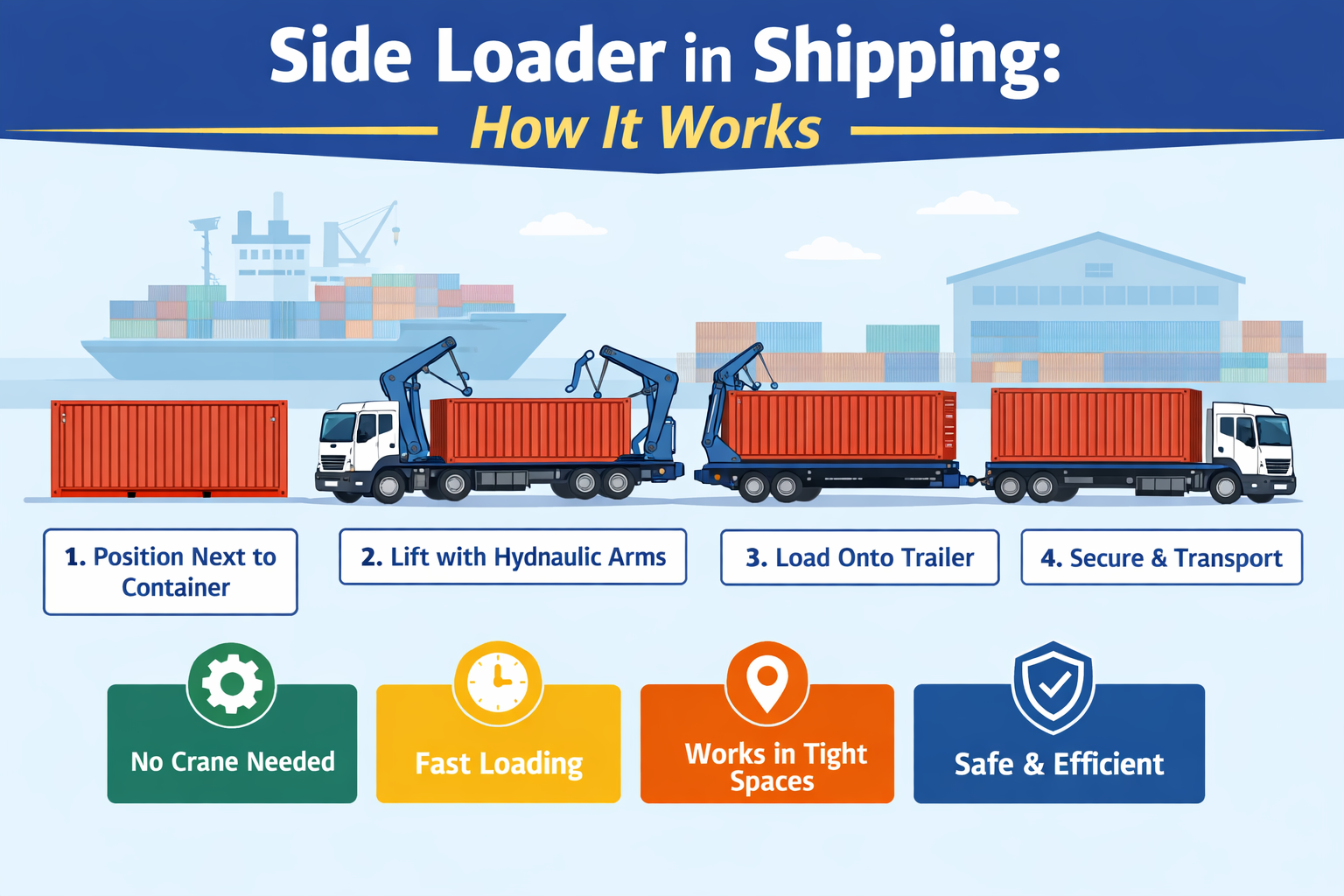
A side loader uses hydraulic arms to lift containers from the side of the vehicle. The process is straightforward:
- The truck positions itself next to the container
- Hydraulic cranes extend and attach to the container
- The container is lifted and placed onto the trailer
- The system secures the container for transport
Because this process does not require external cranes, it significantly reduces handling time and costs in certain situations.
When Do You Need a Side Loader? (With Examples)
Not every shipment requires a side loader. However, in the following scenarios, it becomes the best option:
1. No Loading Equipment at Pickup or Delivery Location
If your supplier or warehouse does not have cranes or forklifts, a side loader can handle the job independently.
Example:
A factory in a rural area needs to ship a 40ft container but lacks loading equipment. A side loader can load the container directly from the ground.
2. Limited Space for Container Handling
In urban or crowded environments, traditional container handling is difficult.
Example:
Delivering a container to a warehouse in a narrow street in Singapore where large cranes cannot operate.
3. Door-to-Door Container Delivery
Side loaders are widely used for door-to-door shipping services.
Example:
A client requests delivery of a container directly to their facility without visiting a port or depot.
4. Heavy or Specialized Cargo
Some cargo requires stable and controlled loading conditions.
Example:
Transporting machinery or fragile industrial equipment that must remain inside the container during loading.
5. Temporary Container Storage Needs
Side loaders can place containers on the ground for short-term storage.
Example:
A construction site needs a container placed on-site for temporary storage of materials.
Advantages of Using a Side Loader
Using a side loader offers several key benefits:
- Flexibility: No need for external cranes or forklifts
- Efficiency: Faster loading and unloading
- Cost Savings: Reduced handling and equipment costs
- Accessibility: Works in tight or remote locations
- Safety: Controlled lifting reduces cargo damage risk
Therefore, side loaders are an essential solution in modern logistics operations.
Side Loader vs Traditional Container Transport
| Feature | Side Loader | Traditional Truck |
|---|---|---|
| Requires crane | No | Yes |
| Works in tight spaces | Yes | Limited |
| Loading flexibility | High | Low |
| Cost efficiency | Medium–High | Depends |
A side loader is a powerful and flexible tool in container transportation. Although it is not required for every shipment, it becomes essential in locations without lifting equipment, in tight spaces, or for specialized cargo handling.
By choosing the right transport method, you can reduce costs, improve efficiency, and ensure smooth delivery.
FAQ
1. What is a side loader used for in shipping?
A side loader is used to load and unload shipping containers without external cranes. It is ideal for locations with limited equipment or space.
2. Is a side loader more expensive than regular transport?
In some cases, yes. However, it can reduce overall costs by eliminating the need for additional lifting equipment and saving time.
3. Can a side loader handle all container sizes?
Most side loaders can handle standard containers such as 20ft and 40ft. However, capacity may vary depending on the equipment.
4. When should I choose a side loader?
You should use a side loader when:
- There is no crane or forklift available
- The delivery location has limited space
- You need door-to-door container transport
5. Is side loader transport safe?
Yes. Side loaders are designed with hydraulic systems that provide stable and controlled lifting, reducing the risk of cargo damage.
Related Posts
- Why Railway Freight Completely Refuses Battery Cargo
- Understanding Container Weight Balance and Uneven Loading in International Shipping
- Why You Should Always Allow Extra Time for International Shipping
- FOB Container Shipping Costs: What You Need to Know
- Post-Chinese New Year Freight Rate Dip: Why March to May May Be Your Best Shipping Window